

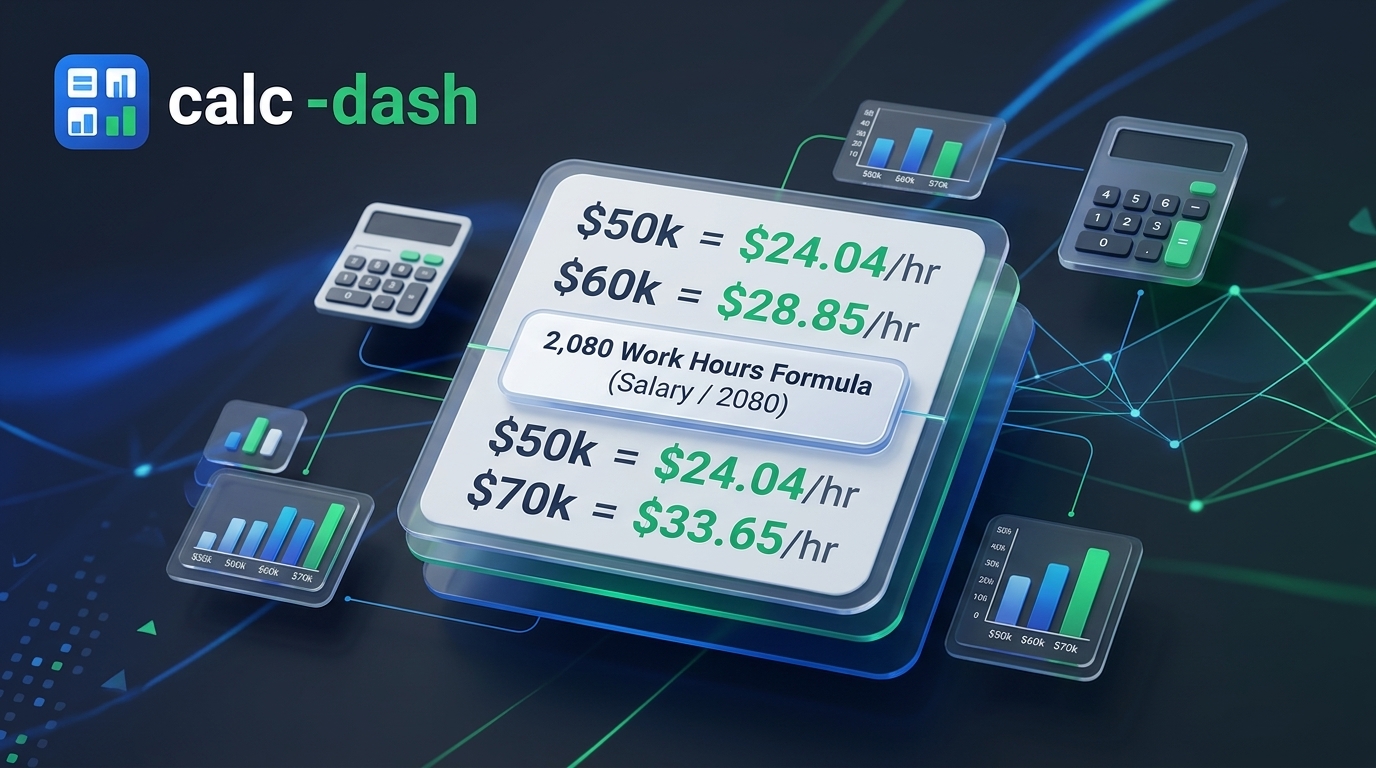
Converting your annual salary into an hourly pay rate requires one standard number: 2,080 working hours. You get this number by multiplying 40 hours per week by 52 weeks in a calendar year.
Divide your base salary by 2,080 to find your gross hourly wage. For example, a $50,000 salary equals $24.04 per hour. A $60,000 salary equals $28.85 per hour. A $70,000 salary equals $33.65 per hour.
Knowing your exact hourly rate helps you compare job offers accurately. It also reveals whether taking a salaried position with unpaid overtime actually lowers your hourly earnings.
Salary to Hourly Rate Conversion Chart ($30k to $150k)
Here is a quick reference conversion table for common annual salaries based on a standard 40-hour workweek:
| Annual Salary | Hourly Pay Rate (40 hrs/wk) | Daily Pay (8 hrs) | Weekly Pay (40 hrs) | Monthly Gross Pay |
|---|---|---|---|---|
| $35,000 | $16.83 / hr | $134.62 | $673.08 | $2,916.67 |
| $40,000 | $19.23 / hr | $153.85 | $769.23 | $3,333.33 |
| $45,000 | $21.63 / hr | $173.08 | $865.38 | $3,750.00 |
| $50,000 | $24.04 / hr | $192.31 | $961.54 | $4,166.67 |
| $55,000 | $26.44 / hr | $211.54 | $1,057.69 | $4,583.33 |
| $60,000 | $28.85 / hr | $230.77 | $1,153.85 | $5,000.00 |
| $65,000 | $31.25 / hr | $250.00 | $1,250.00 | $5,416.67 |
| $70,000 | $33.65 / hr | $269.23 | $1,346.15 | $5,833.33 |
| $75,000 | $36.06 / hr | $288.46 | $1,442.31 | $6,250.00 |
| $80,000 | $38.46 / hr | $307.69 | $1,538.46 | $6,666.67 |
| $90,000 | $43.27 / hr | $346.15 | $1,730.77 | $7,500.00 |
| $100,000 | $48.08 / hr | $384.62 | $1,923.08 | $8,333.33 |
| $120,000 | $57.69 / hr | $461.54 | $2,307.69 | $10,000.00 |
The Step-by-Step Salary to Hourly Formula
You can convert any annual salary into an hourly wage using two quick mathematical steps:
Step 1: Determine Your Total Annual Hours
Multiply your typical weekly working hours by the 52 weeks in a calendar year:
Weekly Hours × 52 Weeks = Total Annual Hours
For standard full-time employment: 40 × 52 = 2,080 hours.
For a 35-hour workweek: 35 × 52 = 1,820 hours.
For a 37.5-hour workweek: 37.5 × 52 = 1,950 hours.
Step 2: Divide Your Annual Salary by Total Hours
Take your total gross salary and divide it by your total yearly hours:
Gross Annual Salary ÷ Total Annual Hours = Hourly Rate
Let us look at a concrete example for a $65,000 salary at 40 hours per week:
$65,000 ÷ 2,080 = $31.25 per hour
How Many Working Hours in a Year?
In payroll accounting, 2,080 hours is the universal standard for full-time workers. However, calendar leap years and paid time off can adjust this number slightly:
- Standard Year (No PTO Deducted): 52 weeks × 40 hours = 2,080 hours.
- Two Weeks Unpaid Leave: 50 weeks × 40 hours = 2,000 hours.
- Federal Holidays (11 Days Off): 2,080 hours minus 88 hours = 1,992 working hours.
- Average Actual Paid Hours: Most salaried employment contracts pay based on the full 2,080-hour threshold regardless of recognized company holidays.
The Hidden Impact of Unpaid Salaried Overtime
Salaried exempt employees do not receive overtime pay when working beyond 40 hours. Extra hours reduce your real hourly pay rate dramatically.
Look at what happens to a $70,000 annual salary when working extended hours:
- At 40 Hours Weekly: 2,080 annual hours = $33.65 per hour.
- At 45 Hours Weekly: 2,340 annual hours = $29.91 per hour ($3.74/hr pay cut).
- At 50 Hours Weekly: 2,600 annual hours = $26.92 per hour ($6.73/hr pay cut).
- At 55 Hours Weekly: 2,860 annual hours = $24.48 per hour ($9.17/hr pay cut).
Working 50 hours per week on a $70,000 salary makes your real earnings identical to a 40-hour worker earning $56,000. Always consider expected weekly hours when evaluating salaried offers.
Hourly vs Salaried: Which Is Better for You?
Choosing between hourly and salaried pay involves distinct trade-offs:
Advantages of Salaried Positions
- Predictable Income: Your paycheck stays identical every month regardless of sick days or slow business periods.
- Better Benefits Packages: Salaried roles frequently include paid parental leave, higher 401(k) matches, and comprehensive healthcare coverage.
- Professional Autonomy: You typically do not need to punch a time clock for doctor appointments or lunch breaks.
Advantages of Hourly Positions
- Overtime Compensation: Every hour worked over 40 qualifies for time-and-a-half pay (1.5x regular wage).
- Protected Personal Time: Employers hesitate to demand evening or weekend tasks when every extra minute costs overtime wages.
- Clear Work Boundaries: When your shift finishes, your workday is officially complete.
Convert Your Salary Instantly with CalcDash
Save time on manual math. Enter your annual salary, weekly work hours, and location into our free CalcDash Salary Calculator. It computes your exact hourly rate, federal tax deductions, state withholdings, and take-home pay in seconds.