

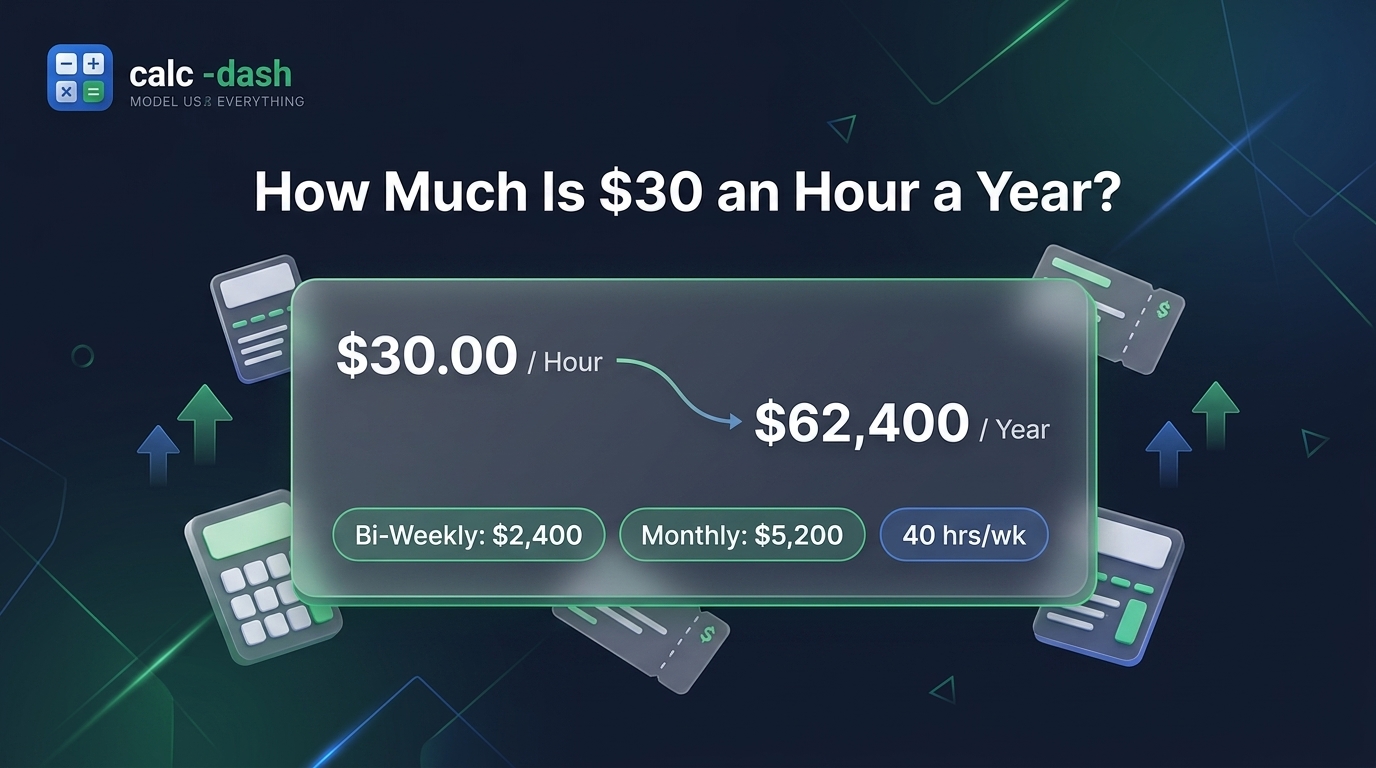
Earning $30.00 per hour on a standard full-time schedule produces a gross annual salary of $62,400 per year before taxes. That breaks down to $5,200.00 each month, $2,400.00 every two weeks, and $1,200.00 per week.
Gross pay is only your starting number. Taxes and payroll withholdings take a notable portion of your paycheck. Your take-home pay is what actually lands in your bank account.
This guide explains your net earnings at $30 per hour across multiple pay frequencies. You will find state tax comparisons, overtime rates, and a realistic monthly budget.
$30 an Hour Paycheck Breakdown Table
Payroll schedules vary by workplace. Here is how $30.00 per hour breaks down across standard working schedules before and after estimated baseline taxes for a single filer:
| Pay Schedule | Gross Earnings (Before Tax) | Estimated Taxes (~20%) | Estimated Take-Home Pay |
|---|---|---|---|
| Hourly Rate | $30.00 | ~$6.00 | $24.00 |
| Daily (8 Hours) | $240.00 | ~$48.00 | $192.00 |
| Weekly (40 Hours) | $1,200.00 | ~$240.00 | $960.00 |
| Bi-Weekly (26 Checks/Year) | $2,400.00 | ~$480.00 | $1,920.00 |
| Semi-Monthly (24 Checks/Year) | $2,600.00 | ~$520.00 | $2,080.00 |
| Monthly (12 Checks/Year) | $5,200.00 | ~$1,040.00 | $4,160.00 |
| Annual (2,080 Hours) | $62,400.00 | ~$12,480.00 | $49,920.00 |
How Is $30 an Hour Calculated Annually?
The standard full-time work year consists of 2,080 working hours. You get this number by multiplying 40 hours per week by 52 weeks in a calendar year.
The core formula is simple:
$30.00 per hour × 2,080 hours = $62,400.00 gross annual salary
Your actual yearly earnings depend on your paid leave policy:
- With Paid Time Off: If your company offers paid vacation and holidays, you receive pay for all 2,080 hours ($62,400).
- With Unpaid Time Off: Taking two weeks of unpaid leave drops your working hours to 2,000. That reduces your annual income to $60,000.00.
- Part-Time at 32 Hours: Working 32 hours weekly equals 1,664 hours per year. That brings your annual gross pay to $49,920.00.
Overtime Pay at $30 an Hour
Under federal FLSA rules, non-exempt hourly employees earn time-and-a-half for all hours worked past 40 hours in a single workweek.
At $30.00 per hour, your overtime rate is:
$30.00 × 1.5 = $45.00 per hour
Putting in regular overtime adds significant extra cash to your yearly total:
- 5 Hours Overtime Weekly: 40 hours at $30 ($1,200) + 5 hours at $45 ($225) equals $1,425.00 weekly ($74,100 gross annually).
- 10 Hours Overtime Weekly: 40 hours at $30 ($1,200) + 10 hours at $45 ($450) equals $1,650.00 weekly ($85,800 gross annually).
Ten hours of overtime per week increases your annual income by over $23,000. That gives you substantial extra room for savings or debt payoff.
What Taxes Come Out of a $30/Hour Paycheck?
Several mandatory payroll deductions come out before your money reaches your account. Here is how those deductions work for a single filer using standard deductions:
1. FICA Taxes (7.65%)
All W-2 wage earners pay FICA taxes across the United States. It includes two parts:
- Social Security (6.2%): Deducts $148.80 from each bi-weekly check ($3,868.80 annually).
- Medicare (1.45%): Deducts $34.80 from each bi-weekly check ($904.80 annually).
Your total FICA withholding equals $183.60 bi-weekly or $4,773.60 per year.
2. Federal Income Tax
Federal tax brackets apply progressively. After taking the standard deduction, your taxable income sits around $47,800. Your effective federal tax rate falls around 11% to 12%. That accounts for roughly $6,800 to $7,400 in annual federal taxes.
3. State and Local Income Taxes
Your state tax rate depends entirely on where you live and work:
- Zero-Tax States (Texas, Florida, Washington, Tennessee, Nevada, Wyoming, South Dakota, Alaska): You pay $0 in state income tax.
- Flat-Tax States (Pennsylvania, Indiana, North Carolina, Colorado): You pay a flat rate between 3.05% and 4.75%.
- Graduated High-Tax States (California, New York, New Jersey, Oregon): You pay progressive state rates between 4% and 7%.
State-by-State Take-Home Pay on a $62,400 Salary
Where you live creates a major difference in your net paycheck at $30 per hour. Here is a comparison of take-home pay for single earners across different states:
| State | State Tax Type | Total Estimated Taxes | Annual Take-Home Pay | Monthly Take-Home |
|---|---|---|---|---|
| Texas | No State Income Tax | ~$11,650 | $50,750 | $4,229 |
| Florida | No State Income Tax | ~$11,650 | $50,750 | $4,229 |
| Washington | No State Income Tax | ~$11,650 | $50,750 | $4,229 |
| Pennsylvania | Flat Tax (3.07%) | ~$13,550 | $48,850 | $4,070 |
| Illinois | Flat Tax (4.95%) | ~$14,700 | $47,700 | $3,975 |
| California | Graduated (~4.2%) | ~$14,250 | $48,150 | $4,012 |
| New York | Graduated + NYC (~6.2%) | ~$15,500 | $46,900 | $3,908 |
Working in a state without an income tax saves you almost $3,800 every year compared to New York City. That equals more than three weeks of extra take-home pay.
Realistic Monthly Budget for $30 an Hour (50/30/20 Rule)
Assuming an average net take-home pay of $4,150.00 per month, here is how to distribute your funds using the 50/30/20 rule:
50% Needs: $2,075 per Month
- Rent and Utilities: $1,450 (Kept comfortably below the 30% gross cap)
- Groceries and Household Goods: $320
- Transportation (Car Payment, Gas, Auto Insurance): $180
- Healthcare Copays and Prescriptions: $125
30% Wants: $1,245 per Month
- Dining Out and Takeout: $350
- Entertainment, Streaming, and Gaming: $225
- Personal Care, Wardrobe, and Shopping: $200
- Weekend Travel and Recreation: $300
- Discretionary Fun Buffer: $170
20% Savings and Debt Payoff: $830 per Month
- Emergency Savings Account: $400
- Retirement Investing (Roth IRA or 401k): $300
- Extra Debt Reduction (Student Loans or Cards): $130
Putting away $830 each month builds nearly $10,000 per year in savings and investments. That habit creates real financial independence on an hourly wage.
How Much Rent Can You Afford on $30 an Hour?
The standard housing rule suggests spending no more than 30% of your gross monthly income on rent. At $30 an hour, your monthly gross is $5,200.00:
$5,200.00 × 0.30 = $1,560.00 per month maximum rent target
Landlords commonly check the 40x rent rule during tenant screening. Dividing your $62,400 annual salary by 40 yields the exact same number:
$62,400 ÷ 40 = $1,560.00 per month
Looking for apartments in the $1,300 to $1,550 range keeps your budget healthy. It ensures you have plenty of room for savings, hobbies, and unexpected expenses.
Comparing Hourly Rates to $30 per Hour
Hourly increases add up quickly over a full working year. Here is how surrounding pay rates compare to $30 per hour:
- $25.00/hr: $52,000 annual gross ($10,400 less per year; $400 less bi-weekly).
- $28.00/hr: $58,240 annual gross ($4,160 less per year; $160 less bi-weekly).
- $30.00/hr: $62,400 annual gross (Baseline).
- $32.00/hr: $66,560 annual gross (+$4,160 per year; +$160 bi-weekly).
- $35.00/hr: $72,800 annual gross (+$10,400 per year; +$400 bi-weekly).
Calculate Your Exact Take-Home Pay Live
Avoid guessing your actual direct deposit amount. Use our free CalcDash Salary Calculator to test your wage, state tax brackets, and pay schedules with real-time accuracy.