

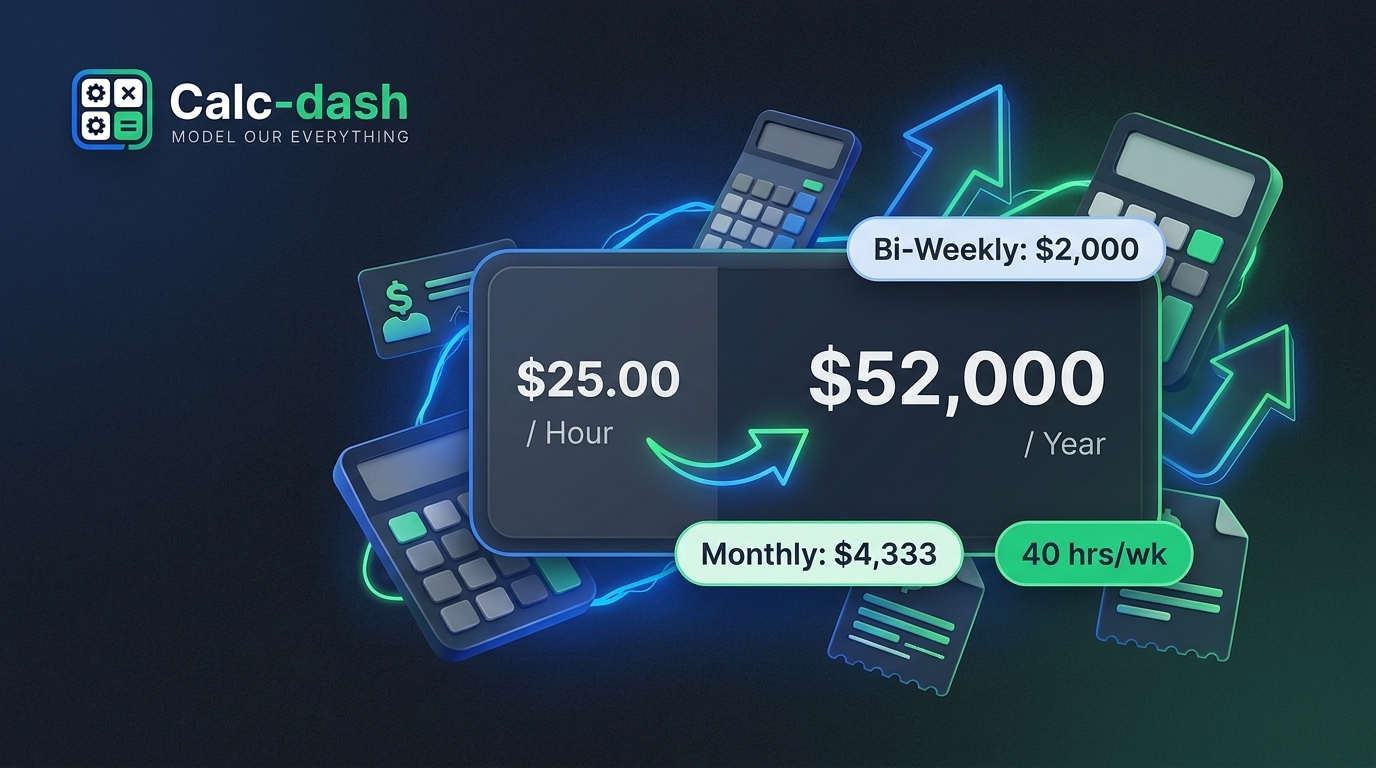
Clocking in at $25.00 per hour on a standard 40-hour workweek produces a gross annual salary of exactly $52,000 per year. That works out to $4,333.33 each month, an even $2,000.00 every two weeks, and $1,000.00 each week before taxes and deductions.
Crossing the $50,000 mark is a significant milestone for hourly professionals. It opens up greater budgeting breathing room, higher savings potential, and the ability to afford comfortable independent housing in many American cities.
However, taxes, retirement contributions, and healthcare costs reduce your gross total. Here is an in-depth, realistic guide breaking down what $25 an hour looks like across every pay frequency, state tax differences, overtime potential, and practical monthly living expenses.
$25 an Hour Paycheck Breakdown Across All Schedules
Here is what your earnings look like across all common payroll frequencies before and after estimated baseline taxes (~19% combined effective rate for a single filer):
| Pay Schedule | Gross Earnings (Before Tax) | Estimated Taxes (~19%) | Estimated Take-Home Pay |
|---|---|---|---|
| Hourly Rate | $25.00 | ~$4.75 | $20.25 |
| Daily (8 Hours) | $200.00 | ~$38.00 | $162.00 |
| Weekly (40 Hours) | $1,000.00 | ~$190.00 | $810.00 |
| Bi-Weekly (26 Checks/Year) | $2,000.00 | ~$380.00 | $1,620.00 |
| Semi-Monthly (24 Checks/Year) | $2,166.67 | ~$411.67 | $1,755.00 |
| Monthly (12 Checks/Year) | $4,333.33 | ~$823.33 | $3,510.00 |
| Annual (2,080 Hours) | $52,000.00 | ~$9,880.00 | $42,120.00 |
The Annual Calculation: Standard Hours vs Unpaid Time Off
The standard baseline for full-time employment in the United States is 2,080 hours per year (40 hours per week × 52 weeks).
The formula is simple:
$25.00 per hour × 2,080 hours = $52,000.00 gross annual salary
Depending on your employer's leave policies, your actual total hours may differ:
- With Paid Holidays and PTO: If your company offers paid leave, your full 2,080-hour salary ($52,000) remains constant.
- With Two Weeks Unpaid Vacation: Working 50 paid weeks yields 2,000 hours, resulting in $50,000.00 in gross annual pay ($25.00 × 2,000 hours).
- Part-Time (32 Hours/Week): Logging 32 hours weekly equals 1,664 hours, bringing your gross pay to $41,600.00 per year.
Overtime Pay at $25 an Hour
If you work in a non-exempt hourly position, any hours worked past 40 hours in a single workweek qualify for time-and-a-half overtime under federal FLSA law.
At $25.00 per hour, your overtime rate is:
$25.00 × 1.5 = $37.50 per hour
Here is the impact of regular weekly overtime on your annual earnings:
- 5 Hours Overtime/Week: 40 regular hours ($1,000) + 5 overtime hours ($187.50) = $1,187.50 per week ($61,750 annual gross).
- 10 Hours Overtime/Week: 40 regular hours ($1,000) + 10 overtime hours ($375.00) = $1,375.00 per week ($71,500 annual gross).
Adding 10 hours of overtime per week lifts your annual compensation from $52,000 to over $71,000, creating substantial extra income for savings or debt reduction.
Detailed Tax Breakdown for $25 an Hour
To understand why your bi-weekly direct deposit is approximately $1,620 rather than $2,000, review the mandatory deductions:
1. FICA Withholding (7.65%)
All W-2 wage earners contribute to Social Security and Medicare:
- Social Security (6.2%): Deducts $124.00 per bi-weekly paycheck ($3,224.00 annually).
- Medicare (1.45%): Deducts $29.00 per bi-weekly paycheck ($754.00 annually).
Total FICA deduction equals $153.00 bi-weekly or $3,978.00 annually.
2. Federal Income Tax
Under current federal income tax brackets, a single earner claiming the standard deduction will see an effective federal tax rate around 9.8% to 10.5%. This accounts for roughly $5,100 to $5,500 in annual federal taxes ($195 to $210 bi-weekly).
3. State and City Income Taxes
State tax laws vary dramatically across the US:
- Zero Income Tax: States like Texas, Florida, Washington, Tennessee, Nevada, and Wyoming take $0.
- Moderate Income Tax: States like Pennsylvania (flat 3.07%), Michigan (flat 4.05%), and Indiana (flat 3.05%) take a predictable flat percentage.
- High Income Tax: States like California (progressive 2%–4%), New York (state + NYC local rate around 5.5%), and Oregon take a larger share.
State-by-State Take-Home Pay on a $52,000 Salary
Here is an exact comparison of what single workers take home on $25 per hour ($52,000 gross) across different states:
| State | State Tax Type | Total Estimated Taxes | Annual Take-Home Pay | Monthly Take-Home |
|---|---|---|---|---|
| Texas | No State Income Tax | ~$9,150 | $42,850 | $3,571 |
| Florida | No State Income Tax | ~$9,150 | $42,850 | $3,571 |
| Washington | No State Income Tax | ~$9,150 | $42,850 | $3,571 |
| Pennsylvania | Flat Tax (3.07%) | ~$10,650 | $41,350 | $3,446 |
| Illinois | Flat Tax (4.95%) | ~$11,400 | $40,600 | $3,383 |
| California | Graduated (~3.8%) | ~$10,950 | $41,050 | $3,421 |
| New York | Graduated + NYC (~5.8%) | ~$11,900 | $40,100 | $3,342 |
A worker in Texas or Florida keeps nearly $2,750 more per year in pure cash compared to a worker in New York City on the exact same $25-an-hour wage.
Realistic 50/30/20 Monthly Budget for $25 an Hour
Assuming an average net take-home pay of $3,510.00 per month (the national average across mixed state tax brackets), here is how to allocate your funds effectively:
50% Needs: $1,755 per Month
- Rent and Utilities: $1,250 (Well within the 30% gross rule)
- Groceries and Essential Food: $280
- Transportation (Car Payment, Insurance, Fuel): $150
- Health Insurance and Prescriptions: $75
30% Wants: $1,053 per Month
- Dining Out, Takeout, and Coffee: $300
- Entertainment, Gaming, and Subscriptions: $200
- Shopping, Clothing, and Grooming: $175
- Hobbies, Travel, and Weekend Outings: $250
- Discretionary Buffer: $128
20% Savings and Debt Payoff: $702 per Month
- Emergency Savings Fund: $350
- Retirement Investing (Roth IRA or 401k): $250
- Extra Debt Reduction (Credit Cards or Loans): $102
By saving $702 every month, you put away over $8,400 per year into savings and investments. Over a five-year period with conservative compound returns, that fund grows to over $48,000.
How Much Rent Can You Afford on $25 an Hour?
Financial guidelines recommend capping your housing costs at 30% of your gross monthly income. At $25 an hour, your gross monthly income is $4,333.33:
$4,333.33 × 0.30 = $1,300.00 per month maximum rent
Using the common 40x rent rule enforced by property managers gives the same ceiling:
$52,000 annual income ÷ 40 = $1,300.00 per month
Aiming for an apartment renting between $1,100 and $1,300 per month keeps your housing costs manageable and prevents you from feeling rent-burdened.
Is $25 an Hour a Good Wage in 2026?
According to data from the US Bureau of Labor Statistics, the median personal income for an individual worker in the United States sits around $41,000. Earning $52,000 puts you roughly 26% above the national median for an individual earner.
In mid-sized metropolitan areas and suburban markets across the Midwest, South, and Mountain West, $25 an hour provides a stable, comfortable quality of life. In top-tier metropolitan hubs with high living costs (like San Francisco, Manhattan, or Seattle), $52,000 will require careful budgeting or shared living arrangements.
Calculate Your Personalized Take-Home Pay
Do not guess what your paycheck will look like. Input your exact hourly wage, pay frequency, and state into our free CalcDash Salary Calculator. It instantly computes your take-home pay, federal brackets, state withholdings, and bi-weekly checks with zero signup required.