

How Much is $23 an Hour a Year?
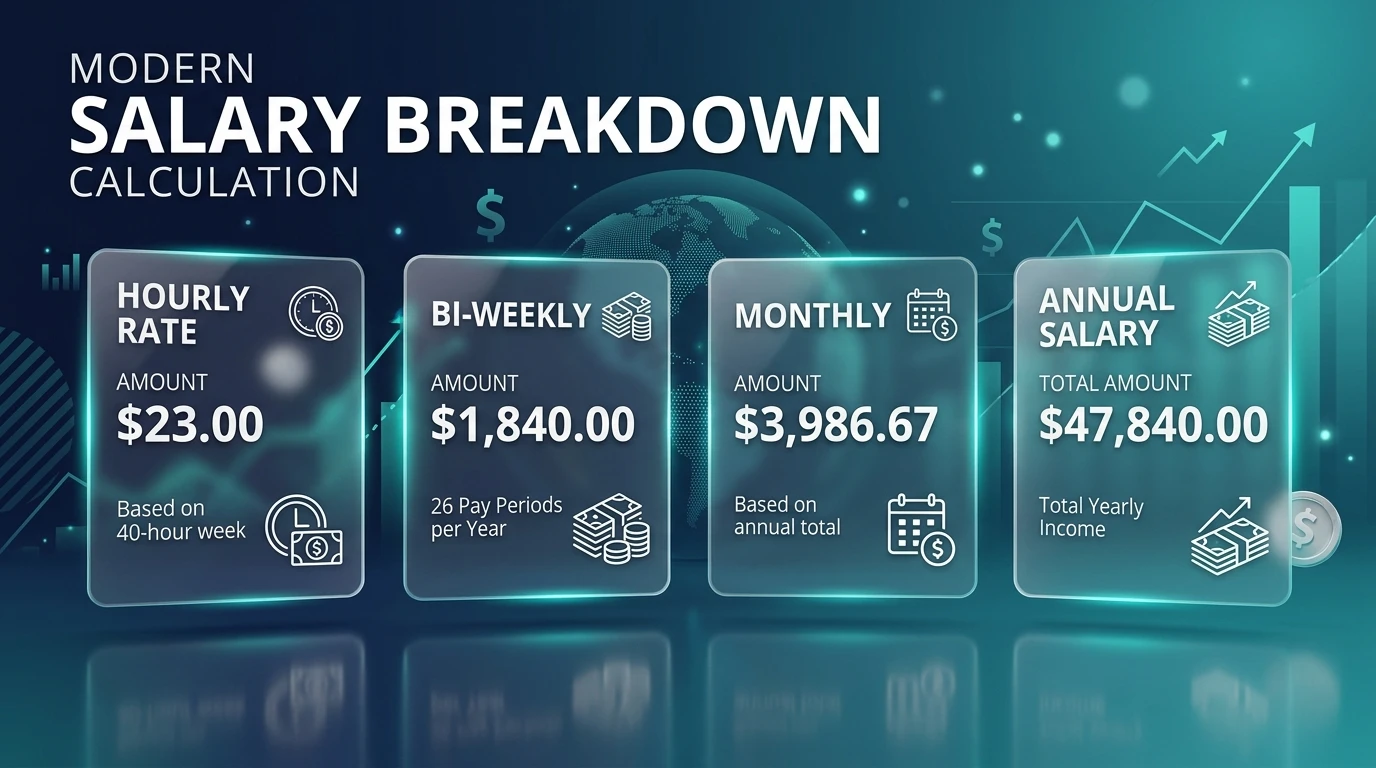
Earning $23 an hour on a standard full-time schedule (40 hours per week, 52 weeks per year) produces a gross annual salary of exactly $47,840 per year before taxes. If you take two weeks of unpaid time off (working 50 weeks or 2,000 hours per year), your gross income is $46,000 per year.
Making $23 an hour is a frequent benchmark in the American workforce, representing thousands of skilled trade, healthcare, customer support, logistics, and administrative occupations. However, budgeting effectively on $23 an hour requires knowing exactly what lands in your checking account after the government deducts mandatory payroll taxes and income taxes.
This comprehensive paycheck guide breaks down everything you need to know about earning $23 per hour: gross vs. net pay across all payroll frequencies, 2026 federal income tax calculations, state-by-state net income comparisons across 12 US states, a realistic 50/30/20 cost of living budget, maximum housing affordability rules, and overtime projections.
Complete $23 an Hour Paycheck Conversion Table (Gross vs. Estimated Net)
Here is how $23.00 per hour calculates across common payment cycles before and after estimated baseline taxes for a single filer (assuming ~16% total federal withholding and FICA):
| Pay Frequency | Work Hours | Gross Pay (Pre-Tax) | Est. Taxes (~16%) | Est. Net Take-Home |
|---|---|---|---|---|
| Hourly | 1 Hour | $23.00 | -$3.68 | $19.32 |
| Daily | 8 Hours | $184.00 | -$29.44 | $154.56 |
| Weekly | 40 Hours | $920.00 | -$147.20 | $772.80 |
| Bi-Weekly (Every 2 Weeks) | 80 Hours | $1,840.00 | -$294.40 | $1,545.60 |
| Semi-Monthly (2x / Month) | 86.67 Hours | $1,993.33 | -$318.93 | $1,674.40 |
| Monthly | 173.33 Hours | $3,986.67 | -$637.87 | $3,348.80 |
| Annual (52 Weeks / 2,080 Hours) | 2,080 Hours | $47,840.00 | -$7,654.40 | $40,185.60 |
The Annual Formula: Converting $23 an Hour into Salary
Converting an hourly wage to an annual salary utilizes the standard full-time baseline of 2,080 hours:
Your actual yearly earnings will vary depending on your employer's holiday and PTO schedule:
- Full-Time with Paid Leave: 52 paid weeks = $47,840 gross.
- 2 Weeks Unpaid Vacation (50 Weeks / 2,000 Hours):
$23 × 2,000 = $46,000gross. - 3 Weeks Unpaid Vacation (49 Weeks / 1,960 Hours):
$23 × 1,960 = $45,080gross. - 4 Weeks Unpaid Vacation (48 Weeks / 1,920 Hours):
$23 × 1,920 = $44,160gross.
$23 an Hour After Taxes in 2026: Federal and State Analysis
Because $47,840 is in the 12% marginal federal tax bracket, your tax burden is relatively moderate. However, payroll taxes and state income taxes still reduce your net pay:
1. Federal Payroll Taxes (FICA)
- Social Security (6.2%):
$47,840 × 0.062 = $2,966.08 per year ($247.17/month). - Medicare (1.45%):
$47,840 × 0.0145 = $693.68 per year ($57.81/month). - Total FICA Withholding: $3,659.76 per year ($304.98/month or $140.76 bi-weekly).
2. Federal Income Tax (2026 Single Filer)
- Gross Income: $47,840
- Standard Deduction (Single Filer): -$15,000
- Taxable Income: $32,840
- 10% Bracket (First $11,925): $1,192.50
- 12% Bracket ($11,925 to $32,840 = $20,915): $2,509.80
- Total Federal Income Tax: $3,702.30 (Effective Federal Tax Rate: ~7.74%)
Combined federal withholding (Income Tax + FICA) is $7,362.06, resulting in a baseline federal net take-home pay of $40,477.94 per year ($3,373.16 per month) in states without an income tax.
State-by-State Take-Home Pay Comparison on $23 an Hour ($47,840)
| State | State Tax Rate | Est. State Tax | Annual Net Pay | Monthly Net Pay | Bi-Weekly Net |
|---|---|---|---|---|---|
| Texas / Florida | 0.00% (No Tax) | $0.00 | $40,478 | $3,373 | $1,557 |
| Washington / Nevada | 0.00% (No Tax) | $0.00 | $40,478 | $3,373 | $1,557 |
| Pennsylvania | 3.07% (Flat) | -$1,469 | $39,009 | $3,251 | $1,500 |
| North Carolina | 4.50% (Flat) | -$1,590 | $38,888 | $3,241 | $1,496 |
| Illinois | 4.95% (Flat) | -$2,240 | $38,238 | $3,186 | $1,471 |
| New York (State Only) | ~4.20% (Progressive) | -$1,780 | $38,698 | $3,225 | $1,488 |
| California (Inc. SDI) | ~3.5% + 1.1% SDI | -$2,045 | $38,433 | $3,203 | $1,478 |
Practical 50/30/20 Budget for Living on $23 an Hour ($3,250 Average Net)
Living on an average monthly take-home pay of $3,250 per month requires diligent allocation of necessities versus discretionary spending:
Fixed, mandatory baseline survival costs:
- Rent / Room Accommodation: $1,050
- Utilities & Phone/Internet: $200
- Groceries & Food Staples: $250
- Gas & Transit Pass: $125
Discretionary lifestyle & personal enjoyment:
- Dining Out & Takeaway: $300
- Entertainment & Streaming: $100
- Personal Care & Clothing: $225
- Weekend Outings & Leisure: $350
Building financial security:
- Emergency Fund: $300
- Roth IRA / Retirement: $250
- Debt Reduction / Buffer: $100
- Annual Savings: $7,800/year
Housing Affordability on $23 an Hour
Adhering to the standard 30% gross income rule:
- Gross Monthly Pay: $3,986.67
- Maximum Recommended Monthly Rent (30%): $1,196 per month
- Conservative Rent Budget (28%): $1,116 per month
In low-to-mid cost of living cities (such as Cleveland, Indianapolis, Kansas City, and Oklahoma City), $1,100 comfortably rents a quality 1-bedroom apartment. In higher-cost metropolitan areas, sharing a 2-bedroom or 3-bedroom apartment with a roommate is the most financially prudent strategy to maintain healthy savings.
Overtime Pay at $23 an Hour
When working overtime beyond 40 hours in a workweek, non-exempt employees receive time-and-a-half:
Double Time Rate (2.0x): $23.00 × 2.0 = $46.00 per hour
| Hours per Week | Weekly Gross | Bi-Weekly Gross | Monthly Gross | Annual Gross Salary |
|---|---|---|---|---|
| 20 Hours (Part-Time) | $460.00 | $920.00 | $1,993.33 | $23,920.00 |
| 30 Hours | $690.00 | $1,380.00 | $2,990.00 | $35,880.00 |
| 40 Hours (Standard Full-Time) | $920.00 | $1,840.00 | $3,986.67 | $47,840.00 |
| 45 Hours (5 Hours Overtime @ $34.50/hr) | $1,092.50 | $2,185.00 | $4,734.17 | $56,810.00 |
| 50 Hours (10 Hours Overtime @ $34.50/hr) | $1,265.00 | $2,530.00 | $5,481.67 | $65,780.00 |
Common Jobs and Career Paths Paying $23 an Hour in 2026
A rate of $23.00 per hour ($47,840 annually) is a prominent milestone across numerous expanding industries. Many of these roles offer excellent career growth, employer benefits, and clear pathways to $30+ per hour:
- Healthcare & Medical Support: Certified Medical Assistants (CMAs), Phlebotomists, Dental Assistants, and Pharmacy Technicians typically earn between $21.50 and $25.00 per hour, providing solid job security and healthcare benefits.
- Skilled Trades & Construction Apprentices: First- and second-year apprentices in electrical, HVAC, plumbing, and carpentry trades commonly start around $22 to $24 per hour, with earning potential doubling upon reaching Journeyman status.
- Information Technology (IT) Support: Tier 1 IT Help Desk Technicians, Computer Support Specialists, and junior QA testers frequently command $22 to $25 per hour while acquiring enterprise certifications (CompTIA Security+, Network+, AWS Cloud Practitioner).
- Logistics & Supply Chain: Warehouse Team Leads, Freight Dispatchers, and Class B Commercial Truck Drivers average $22 to $26 per hour with frequent overtime opportunities.
- Corporate Administration & Bookkeeping: Full-charge Bookkeepers, Payroll Clerks, Executive Administrative Assistants, and Accounts Payable Specialists often earn between $22 and $25 per hour.
$23 an Hour vs. Other Hourly Pay Rates: Annual Comparison
How does $23 an hour compare against adjacent wage benchmarks? Earning an extra $2 to $5 per hour creates a profound financial difference over 2,080 annual work hours:
| Hourly Wage | Weekly Gross (40h) | Monthly Gross | Annual Gross Salary | Annual Difference vs $23/hr |
|---|---|---|---|---|
| $20.00 / hour | $800.00 | $3,466.67 | $41,600.00 | -$6,240 / year |
| $23.00 / hour (Current) | $920.00 | $3,986.67 | $47,840.00 | Baseline |
| $25.00 / hour | $1,000.00 | $4,333.33 | $52,000.00 | +$4,160 / year |
| $28.00 / hour | $1,120.00 | $4,853.33 | $58,240.00 | +$10,400 / year |
| $30.00 / hour | $1,200.00 | $5,200.00 | $62,400.00 | +$14,560 / year |
Strategies to Optimize Your Finances on $23 an Hour
Achieving financial growth on $47,840 gross requires proactive money management and intentional saving habits:
- Automate Your Emergency Fund: Set up an automatic recurring direct deposit of $150 to $200 per paycheck into a high-yield savings account (HYSA). Earning 4.5% to 5.0% APY allows your cash reserves to compound risk-free.
- Capture Employer 401(k) Match: If your company offers a 3% or 4% 401(k) matching contribution, always contribute enough to earn the complete match. It represents an immediate 100% return on investment and lowers your taxable federal gross income.
- Minimize High-Interest Revolving Debt: Carrying credit card debt at 20%+ APR severely erodes a $23/hour income. Focus discretionary funds on eliminating credit card balances first before expanding entertainment spending.
- Upskilling for Rapid Wage Progression: In modern job markets, acquiring industry certifications, trade licenses, or specialized software proficiency can elevate your wage from $23 to $30+ per hour within 12 to 18 months.
Frequently Asked Questions (FAQ) About $23 an Hour
How much is $23 an hour a year after taxes?
For a single filer in 2026, $23 an hour equals $40,478 net per year ($3,373/month) in states with no income tax like Texas and Florida. In states with state income tax (such as Pennsylvania, Ohio, or California), take-home pay ranges between $38,200 and $39,000 per year ($3,180 to $3,250/month).
How much is $23 an hour bi-weekly after taxes?
Your gross bi-weekly paycheck for 80 hours is $1,840.00. After federal tax (~$142) and FICA payroll tax (~$141), baseline federal take-home pay is $1,557.00 per paycheck. With state withholding, net pay is between $1,470 and $1,500.
Is $23 an hour a good wage in the US?
Yes, $23 an hour ($47,840/year) is a respectable wage that falls near the US national median individual income. In most Midwest, Southern, and suburban markets, it provides a solid foundation for independent living and steady personal savings.