

Cumulative GPA Calculator for ASU (Arizona State University)
Calculate your Arizona State University semester GPA, cumulative GPA, Dean's List qualification, and graduation Latin honors using ASU's official 4.0 grading scale with A+ (4.33) honor points.
How to Use Cumulative GPA Calculator ASU
- 1Add each course and enter its credit hours.
- 2Select the letter grade received, including plus or minus grades where applicable.
- 3Enter your previous cumulative GPA and applicable previous graded credit hours if you want to estimate an updated cumulative GPA.
- 4Select Calculate ASU GPA to calculate your semester and cumulative GPA.
- 5Use the result as an estimate and verify your official GPA through your ASU academic record.
Comprehensive Guide to the ASU GPA Calculation System
Official Arizona State University Cumulative GPA Calculation Method
Arizona State University (ASU) computes undergraduate and graduate academic standing using a credit-weighted 4.00 plus/minus scale. The fundamental mathematical equation defined by University Registrar Services determines both term and career GPA:
Under this system, each completed course earns quality points (also called honor points) calculated by multiplying the course's semester credit hours by the numerical grade point value assigned to the earned letter grade. ASU evaluates cumulative GPA to two decimal places (rounded to the nearest hundredth). Although an exceptional mark of A+ yields 4.330 quality points per credit unit, an undergraduate's recorded cumulative GPA cannot exceed 4.000 on official transcripts and commencement programs.
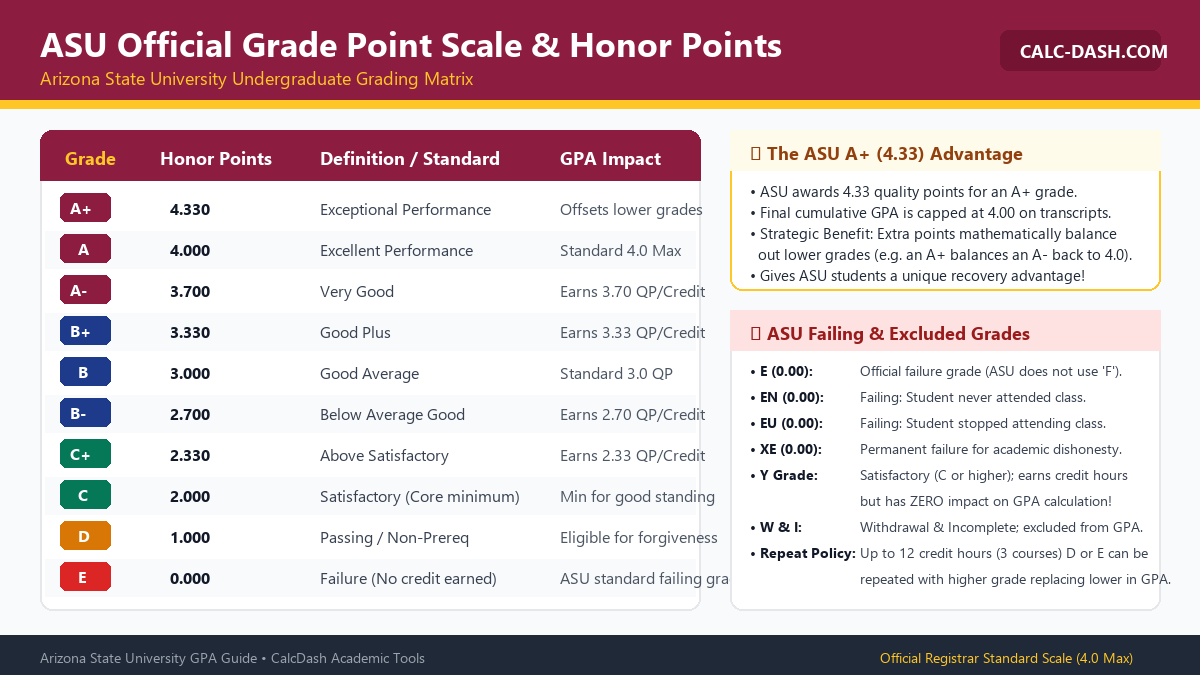
Figure 1: Official Arizona State University undergraduate grading matrix, honor points allocation, and policy rules.
The Complete Arizona State University Letter Grade Matrix
Academic achievement across ASU's Tempe, Downtown Phoenix, Polytechnic, West Valley, and ASU Online campuses is recorded using standardized letter marks. Unlike universities that utilize flat integer grading (where all grades in the B tier count as 3.0), ASU assigns distinct numerical weights to plus and minus distinctions:
- A+ (4.330 Honor Points): Represents academic performance of extraordinary distinction that exceeds typical course standards. While the overall institutional cumulative GPA cannot mathematically exceed 4.00, earning an A+ generates surplus quality points that directly counteract lower grades elsewhere in your academic record.
- A (4.000 Honor Points): Represents excellent mastery of subject material, critical thinking, and fulfillment of all course learning objectives.
- A− (3.700 Honor Points): Reflects very strong academic performance approaching full mastery.
- B+ (3.330 Honor Points): Indicates high-level competency and understanding above standard expectations.
- B (3.000 Honor Points): Demonstrates good, competent comprehension meeting all foundational upper-division standards.
- B− (2.700 Honor Points): Represents slightly below average achievement within the good competency band.
- C+ (2.330 Honor Points): Demonstrates above-satisfactory grasp of core concepts.
- C (2.000 Honor Points): Signifies satisfactory performance. Within the vast majority of ASU undergraduate degree programs, a grade of "C" or better is mandatory in all major coursework, prerequisite sequences, and foundational mathematics or English courses.
- D (1.000 Honor Point): Indicates passing credit with minimum acceptable achievement. While a "D" earns credit hours toward the 120-hour general graduation requirement, it rarely fulfills prerequisite requirements for subsequent courses and is eligible for repetition under ASU's course repeat policy.
- E (0.000 Honor Points): Connotes failing academic performance. Arizona State University does not record "F" on its grade reports; "E" is the official institutional failing designation. Completed credit hours are zero, but enrolled credit hours remain in the GPA calculation denominator, exerting severe downward pull on your cumulative average.
The Mathematical Function of the A+ Grade in Cumulative Standing
Students frequently ask how earning a 4.330 grade value impacts their GPA if transcripts cap cumulative standing at 4.000. In practice, the A+ acts as an internal quality point surplus in the arithmetic numerator.
Consider an ASU student enrolled in 15 semester credit hours across five 3-credit courses who earns one A+ (4.330), two A grades (4.000), one A− (3.700), and one B+ (3.330):
| Course | Credits | Grade | Points per Credit | Total Quality Points |
|---|---|---|---|---|
| Course 1 | 3 | A+ | 4.330 | 12.990 |
| Course 2 | 3 | A | 4.000 | 12.000 |
| Course 3 | 3 | A | 4.000 | 12.000 |
| Course 4 | 3 | A− | 3.700 | 11.100 |
| Course 5 | 3 | B+ | 3.330 | 9.990 |
| Total Semester Record | 15 | — | — | 58.080 Quality Points |
Dividing 58.080 total quality points by 15 credits yields a semester GPA of 3.872. Without the extra 0.99 points provided by the A+ grade (if evaluated at a standard 4.000 value), the total quality points would equal 57.090, resulting in a 3.806 semester GPA. That 0.066 differential can determine whether a student qualifies for competitive internship recruitment or honors distinctions.
Graduate, Law, and Healthcare Program Grading Systems at ASU
Grading policies vary considerably between undergraduate colleges and post-baccalaureate professional programs at Arizona State University:
1. ASU Graduate College Grading Rules
Graduate students enrolled in master's and doctoral degrees (including online graduate programs) operate under stricter academic retention thresholds:
- Minimum Graduation GPA: Graduate degree candidates must maintain a minimum 3.000 cumulative GPA in all work included on the Plan of Study (iPOS), in all post-baccalaureate coursework taken at ASU, and in all graduate-level coursework overall.
- Grades Below C: At the graduate level, grades of "D" or "E" cannot be used to satisfy degree requirements on an iPOS. When a graduate student receives a D or E, zero credit is earned toward degree completion, yet the 0.000 quality points are still calculated into the cumulative graduate GPA.
- Academic Probation: A graduate student whose cumulative GPA drops below 3.000 is immediately placed on academic probation by the Graduate College and granted one semester to raise their standing back to 3.000 before facing academic disqualification.
- Graduation Distinction: Latin honors (Cum Laude, Magna, Summa) are not awarded for graduate degrees. Instead, master's students who complete their program with a flawless 4.000 cumulative GPA receive the designation "With Distinction" on their diplomas and transcripts.
2. Sandra Day O'Connor College of Law
ASU's Sandra Day O'Connor College of Law maintains an independent grading curve designed to ensure consistency across first-year legal curriculum cohorts:
- Mandatory 1L Curve: In all first-year doctrinal classes (Contracts, Torts, Civil Procedure, Constitutional Law, Property, Criminal Law), grades are curved to achieve a median GPA between 3.25 and 3.35.
- Class Rank & Honors: Class rank is computed semi-annually. Order of the Coif eligibility is reserved for students graduating in the top 10% of their law school class.
3. Edson College of Nursing and Health Innovation
Undergraduate nursing students face rigorous clinical progression cutoffs. Direct-admit nursing students must maintain a minimum 3.000 or 3.500 critical tracking GPA in core science prerequisites (including Anatomy & Physiology, Microbiology, and Chemistry) to progress into upper-division clinical cohorts. A single "D" or "E" in any science core prerequisite results in immediate disqualification from clinical sequence advancement until successfully repeated.
4. Ira A. Fulton Schools of Engineering & W. P. Carey School of Business
Both Fulton Engineering and W. P. Carey utilize Critical Tracking Benchmarks during the first four semesters (60 credit hours). Engineering students must maintain a minimum 2.50 to 3.00 core mathematics and science GPA (calculus, physics, chemistry) to be officially admitted into upper-division engineering status. Pre-business students must achieve a 3.00 cumulative ASU GPA and meet prerequisite course grade requirements before enrolling in 300-level business core courses.
Understanding ASU's Administrative and Failing Grade Designations
Arizona State University utilizes four distinct failing designations, each communicating a specific administrative condition to degree audit systems, advising departments, and federal financial aid offices:
| Symbol | Official Title | Quality Points | Academic & Financial Aid Implications |
|---|---|---|---|
| E | Failure | 0.000 | The student completed the semester through final exams but did not demonstrate passing comprehension. Enrolled hours factor into the GPA calculation denominator. |
| EN | Failing – Never Attended | 0.000 | Assigned when an enrolled student never attended a single class, never submitted coursework, or never logged into Canvas. Triggers immediate Title IV financial aid recalculation and potential repayment demands. |
| EU | Failing – Stopped Attending | 0.000 | Assigned when a student attended early in the semester but unofficially withdrew by ceasing attendance prior to the withdrawal deadline without completing assessments. Instructors must report the last date of attendance. |
| XE | Academic Dishonesty Failure | 0.000 | Permanent disciplinary failing grade conferred following formal university review of egregious academic integrity policy violations. Recorded permanently on the transcript and cannot be replaced under the repeat policy. |
Non-GPA Transcript Markers and Special Symbols
Several official transcript symbols carry zero quality points and are completely excluded from GPA calculations:
- Y (Satisfactory / Pass): Used in courses approved for Pass/Fail grading. A grade of "Y" corresponds to performance at a "C" level or higher. You earn full credit hours toward graduation, but no honor points are computed and the hours are excluded from the GPA denominator.
- W (Withdrawal): Recorded when you drop a class after the drop deadline but prior to the single-course withdrawal deadline. The course appears as a "W" on your transcript, awards no credit, and carries zero GPA penalty.
- I (Incomplete): A temporary placeholder granted when a student has finished at least 80% of coursework with passing standing but experiences a documented medical or personal emergency. The student has one calendar year to complete remaining work; if left unresolved, it automatically converts to an "E" (0.000).
- X (Audit): Enrollment for instructional observation without credit or grades.
- NR (No Report): A temporary administrative placeholder indicating that the instructor has not yet submitted final term grades.
- Z (Course in Progress): Assigned in continuous multi-semester coursework, such as honors theses or graduate dissertations.
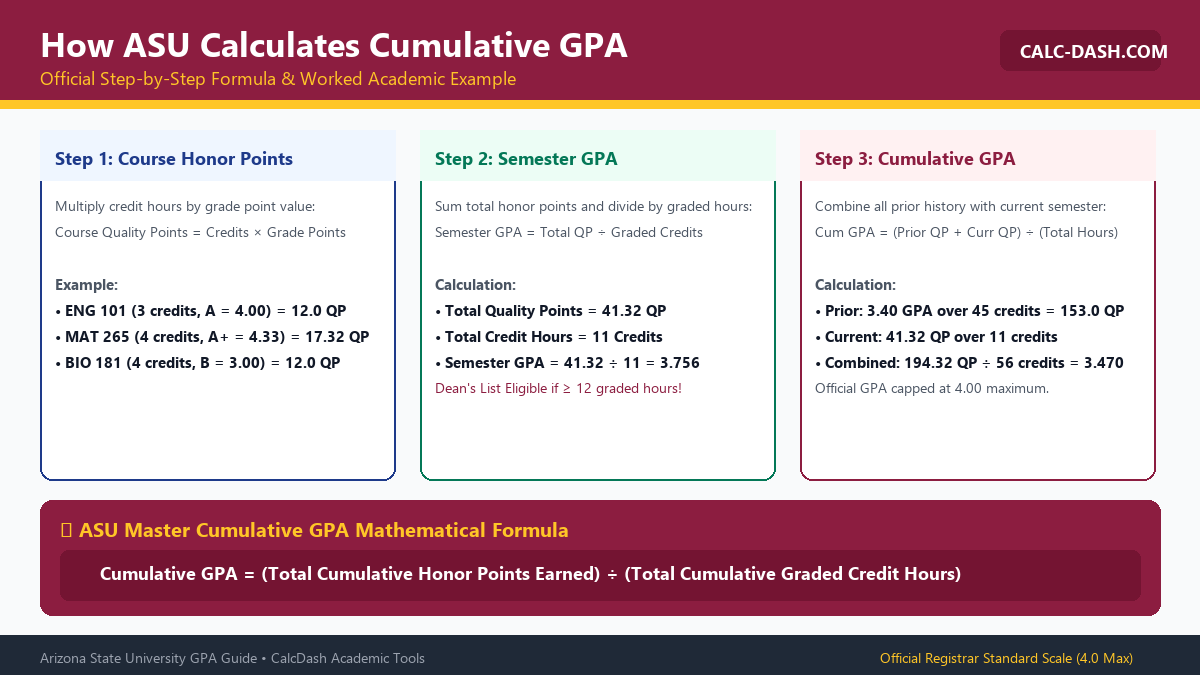
Figure 2: Three-step mathematical calculation flowchart for ASU semester and cumulative GPA.
ASU Session Structure: How Sessions A, B, and C Combine into Term GPA
One of Arizona State University's distinctive academic formats is its division of fall, spring, and summer terms into multiple modular sessions:
- Session A: Accelerated 7.5-week term covering the first half of the semester.
- Session B: Accelerated 7.5-week term covering the second half of the semester.
- Session C: Traditional full 15-week semester (spanning the full duration of Session A and B).
A critical operational policy that many ASU Online and immersion students misunderstand is how term GPA and Dean's List eligibility are certified across these sessions:
How Session Grades Combine into Official Semester Records:
ASU does not compute separate official transcript GPAs for Session A and Session B. Instead, all courses completed across Session A, Session B, and Session C within the same fall or spring semester are combined into a single, unified semester GPA. For example, if you complete 6 credits in Session A and 6 credits in Session B, your total graded term enrollment is 12 credit hours. If your combined term GPA across all 12 hours is 3.500 or higher, you satisfy the full 12-credit minimum threshold to earn Dean's List recognition for that semester!
Five Step-by-Step Worked Academic Scenarios
To help you model your academic trajectory, here are five comprehensive mathematical demonstrations illustrating common student situations:
Case Study 1: First-Year Undergraduate Student (15-Credit Fall Term)
An incoming first-year student completes five standard lower-division courses:
- ENG 101 (3 credits, A = 4.000): 3 × 4.000 = 12.000 Quality Points
- MAT 265 (4 credits, A+ = 4.330): 4 × 4.330 = 17.320 Quality Points
- CHM 113 (4 credits, B+ = 3.330): 4 × 3.330 = 13.320 Quality Points
- ASU 101 (1 credit, A = 4.000): 1 × 4.000 = 4.000 Quality Points
- PSY 101 (3 credits, B = 3.000): 3 × 3.000 = 9.000 Quality Points
Total Semester Quality Points: 12.000 + 17.320 + 13.320 + 4.000 + 9.000 = 55.640 Quality Points.
Total Graded Credit Hours: 3 + 4 + 4 + 1 + 3 = 15 Credit Hours.
Semester GPA: 55.640 ÷ 15 = 3.709 Semester GPA.
Honors Recognition: Because the student completed 15 graded hours (meeting the 12-credit floor) and earned a GPA above 3.50, they are officially recognized on the Dean's List.
Case Study 2: Sophomore Midterm Recovery (Balancing Lower Grades with A+)
A sophomore takes a heavy 16-credit course load including organic chemistry:
- CHM 233 (3 credits, C+ = 2.330): 3 × 2.330 = 6.990 QP
- CHM 237 (1 credit lab, A = 4.000): 1 × 4.000 = 4.000 QP
- BIO 201 (4 credits, A+ = 4.330): 4 × 4.330 = 17.320 QP
- HST 109 (3 credits, A = 4.000): 3 × 4.000 = 12.000 QP
- ECN 211 (3 credits, B− = 2.700): 3 × 2.700 = 8.100 QP
- PHI 101 (2 credits, A+ = 4.330): 2 × 4.330 = 8.660 QP
Total Quality Points: 6.990 + 4.000 + 17.320 + 12.000 + 8.100 + 8.660 = 57.070 QP.
Semester GPA: 57.070 ÷ 16 = 3.567 Semester GPA.
Takeaway: The two A+ grades generated surplus quality points that completely absorbed the C+ and B− grades, keeping the semester GPA above the 3.50 Dean's List benchmark.
Case Study 3: Junior Cumulative Inertia (Integrating 60 Prior Credits)
A junior enters the spring term with 60 completed credit hours and a 3.200 cumulative GPA. This represents:
Prior Cumulative Quality Points = 60 credits × 3.200 GPA = 192.000 Quality Points
They achieve a strong spring semester earning 14 credits with a 3.850 semester GPA (53.900 new quality points).
Combined Quality Points = 192.000 + 53.900 = 245.900 Quality Points
Combined Graded Credit Hours = 60 + 14 = 74 Graded Credit Hours
Updated Cumulative GPA = 245.900 ÷ 74 = 3.323 Cumulative GPA
Notice that despite an outstanding 3.850 semester, the cumulative GPA moved upward by 0.123 points (from 3.200 to 3.323). This demonstrates cumulative inertia: as your completed credit base expands, each new semester exerts proportionally less leverage on your overall career average.
Case Study 4: Senior Graduation Honors Push (Hitting Latin Honors Tiers)
A senior has completed 105 credits with a 3.360 cumulative GPA (352.800 quality points). To graduate Cum Laude, they need a final cumulative GPA of at least 3.400 upon completing their remaining 15 credits (reaching 120 credits total).
We calculate the target quality points needed at graduation:
Required Total Quality Points = 120 total credits × 3.400 target GPA = 408.000 Quality Points
Points Needed in Final Term = 408.000 − 352.800 = 55.200 Quality Points
Required Final Semester GPA = 55.200 ÷ 15 credits = 3.680 Semester GPA
The student now has a precise academic target: they must achieve a minimum 3.680 GPA in their final 15 credits (such as three A grades and two B+ grades) to cross the threshold for Cum Laude graduation honors.
Case Study 5: The Math of Repeating a Course Under Grade Forgiveness
A sophomore earned an "E" (0.000) in a 4-credit physics course, leaving them with 30 credits and a 2.400 cumulative GPA (72.000 quality points).
In the subsequent term, they retake the 4-credit course and earn an "A" (4.000). Under ASU's course repeat policy:
- The original 0.000 quality points are removed, and 4 credits are subtracted from the previous denominator.
- The new attempt adds 16.000 quality points (4 × 4.000) and adds 4 credits back into the denominator.
Adjusted Quality Points = 72.000 − 0.000 (old E) + 16.000 (new A) = 88.000 Quality Points
Adjusted Graded Hours = 30 credits (unchanged, since 4 hours were replaced)
New Cumulative GPA = 88.000 ÷ 30 = 2.933 Cumulative GPA!
Retaking a single 4-credit class instantly raised their cumulative GPA from a 2.400 to a 2.933—a dramatic jump of over half a letter grade!
Arizona State University Course Repeat and Grade Forgiveness Regulations
Undergraduate students struggling with an early low grade should consult the official ASU Undergraduate Course Repeat Policy. The key provisions established by University Registrar Services are:
Official ASU Course Repeat Criteria:
- Initial Grade Qualification: Grade replacement is strictly permitted for courses where the initial grade earned was a D or E (including EN or EU). Courses in which a student earned a C or higher cannot be repeated for grade replacement.
- Credit Hour Cap: Students may repeat up to a university maximum of 12 credit hours (or up to 3 individual courses, whichever threshold is reached first) under the grade replacement policy during their entire undergraduate career.
- Calculation Rule: When a course is repeated under this policy, only the subsequent grade earned is factored into the cumulative GPA calculation, even if the subsequent grade is lower. The previous D or E mark is completely removed from the cumulative GPA computation.
- Transcript Transparency: The original course attempt is never erased from your official transcript. Instead, it is annotated with an administrative marker indicating that the course was subsequently repeated.
- Campus Residency Requirement: Both course attempts must be completed at Arizona State University. You cannot replace an ASU grade by transferring in coursework completed at a community college or another university.
- Beyond 12 Credit Hours: If an undergraduate repeats a course after exceeding the 12-credit-hour limit, both grades will remain in the GPA denominator and be averaged together.
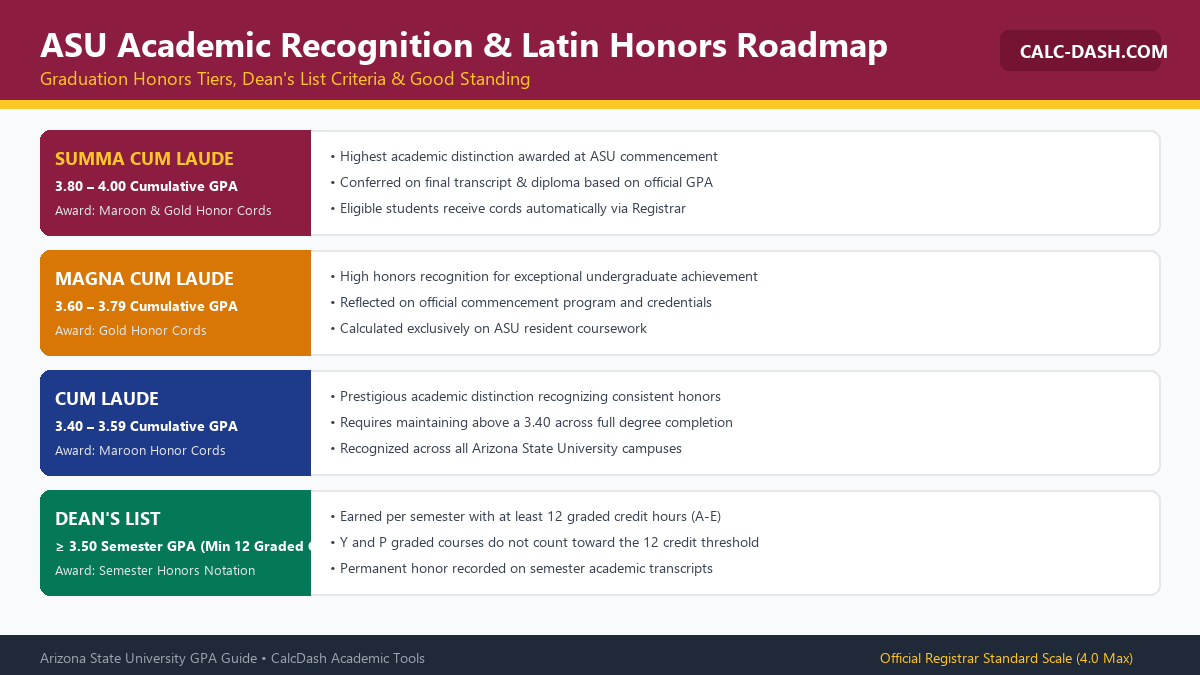
Figure 3: Arizona State University graduation Latin honors tiers, Dean's List requirements, and academic standing benchmarks.
Target Cumulative GPA Planning & Reverse Calculation Formulas
Many students use our calculator to answer proactive planning questions: "What GPA do I need this semester to graduate with honors?" or "What score do I need on my final exam to earn an A?" You can solve these targets using the standard algebraic formulas below:
Formula 1: Target Semester GPA Required for a Cumulative Goal
If you have completed a set number of credit hours and wish to reach a target cumulative GPA by the end of the upcoming semester, use this equation:
Example: You have 45 credits at a 3.200 GPA (144.000 QP) and want to reach a 3.400 cumulative GPA after taking 15 credits this term (totaling 60 credits):
Target Semester GPA = [(3.400 × 60) − 144.000] ÷ 15
Target Semester GPA = [204.000 − 144.000] ÷ 15 = 60.000 ÷ 15 = 4.000
You must earn a straight 4.000 (all A or A+ grades) in your 15 upcoming credits to lift your cumulative average to 3.400.
Formula 2: Course Final Exam Score Planner
To determine the exact grade you need on your final exam to secure your target course letter grade:
Example: You currently have an 88.0% in MAT 265 going into a final exam worth 25% of your grade (0.25), and you need a 93.0% overall to secure an A:
Required Exam Score = [93.0 − (88.0 × (1 − 0.25))] ÷ 0.25
Required Exam Score = [93.0 − (88.0 × 0.75)] ÷ 0.25 = [93.0 − 66.0] ÷ 0.25 = 27.0 ÷ 0.25 = 108.0%
Because 108% is unattainable without extra credit, achieving an A is mathematically impossible, but you can calculate what score secures an A− (90.0% cutoff requires an 96.0% on the final).
Academic Standing, Probation, Disqualification, and Academic Renewal
At the close of each fall and spring semester, ASU's academic standards committees review every enrolled student's record:
- Good Academic Standing (GPA ≥ 2.000): The foundational requirement for enrollment continuation, financial aid eligibility, and degree conferral across all undergraduate colleges.
- Academic Warning: Conferred when an undergraduate student has attempted fewer than 24 total credit hours at ASU and their cumulative GPA falls between 1.500 and 1.999. Serves as a developmental notice before formal probation is enacted.
- Academic Probation: Imposed when an undergraduate student's cumulative GPA drops below 2.000 after completing 24 or more credit hours. While on probation:
- You are restricted to enrolling in no more than 12 or 13 credit hours per term.
- You must meet with an assigned academic success specialist to formulate an Academic Improvement Plan.
- You may be barred from holding leadership positions in student organizations or Greek life.
- Continuing Probation: Granted if a student on probation achieves a semester GPA of 2.000 or higher during their probationary term, but their cumulative GPA has not yet reached the 2.000 threshold.
- Academic Disqualification: Occurs when a student on probation fails to achieve the minimum term GPA mandated by their academic college. Disqualified students are suspended from university enrollment for a minimum of one calendar year.
- ASU Academic Renewal Policy ("Fresh Start"): Students who have been absent from Arizona State University for at least five consecutive calendar years may apply for readmission under Academic Renewal. If approved, previous grades of D and E are excluded from the cumulative GPA computation, providing returning adult learners a genuine fresh start toward degree completion.
Scholarship Retention and Financial Aid GPA Benchmarks
Retaining merit-based institutional funding requires proactive semester GPA management:
1. ASU New American University Scholarships
The President's Award, Provost's Award, Dean's Award, and University Scholarship provide multi-year undergraduate tuition support subject to strict renewal criteria:
- Cumulative GPA Floor: Recipients must maintain an ASU cumulative GPA of at least 3.000 evaluated at the conclusion of each spring semester.
- Annual Credit Hour Completion: Students must successfully complete at least 30 credit hours during each academic year (Fall plus Spring semesters). Summer credits completed at ASU may be counted to reach the 30-hour benchmark.
- Scholarship Probation: If your cumulative GPA falls between 2.750 and 2.999 at the end of spring, you may be granted a one-year probationary period to raise your average back to 3.000 without immediate forfeiture of funds.
2. Barrett, The Honors College
Students enrolled in Barrett, The Honors College must satisfy heightened academic standards:
- Maintain a minimum 3.250 cumulative ASU GPA. If your cumulative GPA dips below 3.250, you are placed on honors probation for one semester.
- Complete 36 honors credit hours (for 4-year students) or 18 honors credits (for upper-division transfers), including an approved Honors Thesis / Creative Project defense.
3. Satisfactory Academic Progress (SAP) for Federal Aid
Federal Pell Grants, Direct Subsidized and Unsubsidized Loans, and parent PLUS loans require meeting federal SAP benchmarks:
- Maintain a minimum cumulative GPA of 2.000.
- Maintain a minimum pace of completion of at least 67% (total completed credit hours divided by total attempted credit hours). Marks of W, E, EN, and I count as attempted but non-completed hours.
- Complete degree requirements within 150% of the published program credit length (typically 180 attempted hours for a 120-hour bachelor's degree).
Transfer Credits, Community College Articulation, and Transfer Shock
Arizona State University welcomes thousands of transfer students annually, especially from Maricopa Community Colleges (such as Mesa, Scottsdale, Glendale, and Chandler-Gilbert) via the MyPath2ASU / MAPP articulation pathways. Understanding how transfer credits interact with the ASU GPA is essential:
- The Zero GPA Transfer Rule: Coursework completed at external community colleges or universities transfers strictly as credit hours toward your degree requirements. External grades carry zero quality points and have no impact on your ASU institutional cumulative GPA.
- The Reset Phenomenon: When an incoming transfer student begins classes at ASU, their official ASU cumulative GPA starts at exactly 0.000. Their first-semester grades at ASU will constitute 100% of their institutional cumulative GPA.
- Overcoming "Transfer Shock": Transfer students entering rigorous upper-division university coursework often experience a temporary drop in term GPA compared to community college averages. Because there is no large buffer of lower-division ASU grades, an early B− or C can sharply lower your starting ASU average. Focus on balanced course scheduling during your initial transition term.
Graduation with Academic Recognition (Latin Honors Tiers)
Baccalaureate degree candidates who achieve exemplary cumulative GPAs are recognized at university commencement and on official diplomas:
| Latin Distinction | Minimum Cumulative GPA | Commencement Honor Cord | Official Credential Recording |
|---|---|---|---|
| Summa Cum Laude | 3.800 – 4.000 | Maroon and Gold Braided Cords | Conferred on Diploma & Official Transcript |
| Magna Cum Laude | 3.600 – 3.799 | Gold Honor Cords | Conferred on Diploma & Official Transcript |
| Cum Laude | 3.400 – 3.599 | Maroon Honor Cords | Conferred on Diploma & Official Transcript |
| Dean's List (Per Term) | ≥ 3.500 Semester GPA | Dean's Certificate & Notation | Recorded on Semester Transcript Notation |
Strategic Guidelines for Maximizing Your Academic Record
Achieving top academic standing at Arizona State University is both an intellectual and mathematical endeavor. Keep these strategic principles in mind:
- Capitalize on High-Credit Courses Early: A 4-credit laboratory or engineering course carries 33% more numerical weight than a 3-credit lecture. Prioritize study hours toward your highest-credit courses to maximize quality point production.
- Protect Against Cumulative Drag: Early poor performance creates lasting downward drag. In your junior and senior years, lifting a 3.10 to a 3.40 requires near-perfect semesters. Front-load academic rigor during your freshman and sophomore years when each credit exerts maximum upward leverage.
- Use Course Withdrawal Defensively: If you face an unavoidable D or E grade due to unexpected personal or medical difficulties, dropping prior to the single-course withdrawal deadline awards a neutral "W". While a "W" carries no credit, it prevents catastrophic grade point deflation.
- Pursue A+ Bonus Potential: If your syllabus offers extra credit or you are sitting at a 97% or 98%, push for the A+. Earning 4.330 quality points per credit unit gives you a mathematical cushion against challenging future courses.
Explore More Helpful Academic and Calculation Tools
Support your university planning and financial budgeting with our suite of free online calculators:
- Read our comprehensive editorial analysis: How to Calculate ASU Cumulative GPA – Student Guide & FAQ.
- Calculate percentage changes and exam grade weights with our Percentage Calculator.
- Explore career earnings, salary projections, and hourly rates in our Full CalcDash Tools Directory.
How the ASU GPA Calculator Works
Arizona State University calculates GPA by multiplying each course's credit hours by its assigned grade point value to determine honor points (quality points). All honor points are totaled and divided by total net graded credit hours.
ASU rounds grade point averages to the nearest hundredth (0.01). While ASU assigns 4.33 honor points to an A+, the cumulative GPA is capped at 4.00 on official university transcripts.
1. Course Quality Points = Course Credit Hours × Letter Grade Value
2. Semester GPA = (Total Semester Quality Points) ÷ (Total Semester Graded Credit Hours)
3. Cumulative GPA = (Prior Quality Points + Current Quality Points) ÷ (Prior Graded Hours + Current Graded Hours)
* Note: Maximum official cumulative GPA displayed on ASU transcripts is capped at 4.00.
Worked Example: ASU Semester & Cumulative GPA with Prior Academic History
- Current Semester Courses: ACC 230 (3 cr, A = 4.00): 3 × 4.00 = 12.00 QP; MGT 301 (3 cr, B+ = 3.33): 3 × 3.33 = 9.99 QP; ECN 212 (3 cr, A− = 3.70): 3 × 3.70 = 11.10 QP; CIS 105 (3 cr, A+ = 4.33): 3 × 4.33 = 12.99 QP.
- Current Semester Totals: 12.00 + 9.99 + 11.10 + 12.99 = 46.08 Total Quality Points across 12 graded credit hours.
- Semester GPA: 46.08 QP ÷ 12 credits = 3.840 Semester GPA. Because the student completed ≥ 12 graded credit hours with a GPA ≥ 3.50, they have earned Dean's List recognition!
- Prior History Integration: Student entered semester with a 3.35 cumulative GPA over 45 graded credit hours (45 × 3.35 = 150.75 prior QP).
- Updated Cumulative GPA: (150.75 prior QP + 46.08 semester QP) ÷ (45 prior hours + 12 semester hours) = 196.83 ÷ 57 = 3.453 Cumulative GPA.
Updated Cumulative GPA = 3.453. The student achieved Dean's List this term (3.84 semester GPA) and successfully lifted their cumulative GPA into the Cum Laude honors range (≥ 3.40).
Official ASU Academic Reference Data
ASU Letter Grade to Honor Points Matrix
| Letter Grade | Grade Point Value (Honor Points) | Academic Definition | GPA Impact |
|---|---|---|---|
| A+ | 4.330 | Exceptional Achievement | Earns 4.33 QP/credit; buffers lower grades; cumulative capped at 4.00 |
| A | 4.000 | Excellent Mastery | Standard 4.00 QP/credit |
| A- | 3.700 | Very Strong Performance | Earns 3.70 QP/credit |
| B+ | 3.330 | High Average Competency | Earns 3.33 QP/credit |
| B | 3.000 | Good / Competent | Standard 3.00 QP/credit |
| B- | 2.700 | Below Average Competency | Earns 2.70 QP/credit |
| C+ | 2.330 | Above Satisfactory | Earns 2.33 QP/credit |
| C | 2.000 | Satisfactory Passing | Minimum grade required for major prerequisites & core courses |
| D | 1.000 | Minimum Passing / Low | Earns degree credits, but ineligible for prereqs; eligible for course repeat |
| E | 0.000 | Failure (Zero Credit) | ASU standard failing grade; factored into GPA denominator as 0.00 |
Source: Arizona State University Registrar Services Undergraduate Catalog Grading System.
ASU Academic Recognition & Graduation Latin Honors Thresholds
| Designation / Honor | Minimum Cumulative GPA | Credit Hour Thresholds | Award / Recognition |
|---|---|---|---|
| Summa Cum Laude | 3.80 – 4.00 | Undergraduate degree completion | Maroon and Gold Braided Honor Cords; Conferred on Diploma |
| Magna Cum Laude | 3.60 – 3.79 | Undergraduate degree completion | Gold Honor Cords; Conferred on Diploma |
| Cum Laude | 3.40 – 3.59 | Undergraduate degree completion | Maroon Honor Cords; Conferred on Diploma |
| Dean's List | ≥ 3.50 (Semester) | Minimum 12 graded credit hours in fall or spring term | Permanent semester notation on official academic transcript |
| Barrett Honors Standing | ≥ 3.25 (Cumulative) | Continuous enrollment in Barrett, The Honors College | Honors scholar recognition & thesis completion |
| Good Academic Standing | ≥ 2.00 (Cumulative) | All active undergraduate degree-seeking students | Standard enrollment status without probation |
| Academic Probation | < 2.00 (Cumulative) | Term cumulative review | Mandatory advising, credit limit restriction (12–13 credits max) |
Source: ASU University Registrar Graduation with Academic Recognition Policies.
ASU Special Grading Symbols and Non-GPA Designations
| Grade Symbol | Meaning | Credit Hours Earned | GPA Calculation Effect |
|---|---|---|---|
| Y | Satisfactory (Pass) | Yes (Degree credit earned) | None (Excluded from GPA numerator & denominator) |
| W | Official Withdrawal | No credit | None (Zero GPA impact; recorded on transcript) |
| I | Incomplete | Pending completion | None temporarily; converts to E (0.00) if incomplete after 1 year |
| X | Audit (No Credit) | No credit | None (Excluded from GPA) |
| EN | Failing - Never Attended | No credit | 0.00 Honor Points (Factored into GPA denominator as failure) |
| EU | Failing - Stopped Attending | No credit | 0.00 Honor Points (Factored into GPA denominator as failure) |
| XE | Academic Dishonesty Failure | No credit | 0.00 Honor Points (Permanent disciplinary notation on transcript) |
| NR | Grade Not Reported | Pending submission | None (Temporary marker until instructor submits grades) |
| Z | Course in Progress | In progress | None (Used for multi-term thesis or research sequences) |
Source: ASU Office of the University Registrar Special Grading Symbols.
Who Uses This Tool and Why
- ✓ASU undergraduates entering finals week calculate what grades they need on remaining exams to achieve a 3.5 semester GPA and earn Dean's List recognition for that term.
- ✓Students approaching graduation enter their current cumulative GPA and expected final semester grades to determine whether they will graduate Cum Laude, Magna Cum Laude, or Summa Cum Laude.
- ✓ASU students on academic probation use the calculator to model how many credit hours of strong grades are needed to raise their cumulative GPA above 2.0 and exit probation.
- ✓Transfer students should distinguish between transfer credit and the GPA calculated from coursework included in their ASU academic record. The treatment of transfer coursework can depend on ASU policies and the type of credit. Students should verify how their transfer coursework is reflected in My ASU or their official academic record.
- ✓Students preparing for graduate or professional programs can use the calculator to monitor their cumulative GPA and model how future coursework may affect their academic record. Admission requirements and competitive GPA ranges vary by institution and program.
Limitations & Practical Academic Tips
Important Limitations
- •This online calculator provides an accurate mathematical simulation based on ASU published standards, but does not replace official grade audits from My ASU or the University Registrar.
- •Transfer credits from community colleges or other universities transfer credit hours toward degree completion but DO NOT factor into the ASU institutional cumulative GPA.
- •Course Repeat / Grade Forgiveness adjustments are subject to university approval and are limited to 12 credit hours (maximum 3 courses) where the original grade was a D or E.
- •Special courses evaluated on a Pass/Fail or Y-grade basis earn degree credit hours but must be excluded from this calculator's graded course entries.
- •Graduate students at ASU are evaluated on a separate grading policy where grades below 'C' receive 0.00 honor points and Latin honors do not apply (though 4.00 graduates earn 'With Distinction').
Strategic Tips for Best Results
- →Take advantage of A+ grades: At ASU, an A+ carries 4.330 quality points. While your transcript cumulative GPA is capped at 4.00, extra honor points from an A+ mathematically offset lower marks (such as A- or B+ grades).
- →Remember that ASU uses E, not F: If your grade report indicates an E, EN, EU, or XE, select 'E' (0.00) in the calculator.
- →Meet the 12-credit threshold for Dean's List: Achieving a 3.50+ semester GPA only earns Dean's List recognition if you completed at least 12 graded credit hours (A through E). Courses graded Y, P, or W do not count toward this 12-credit requirement.
- →Monitor the credit inertia curve: Cumulative GPA becomes significantly more stable as you accumulate credits. Prioritize GPA optimization during your freshman and sophomore years.
Frequently Asked Questions About ASU GPA Calculation
- How does Arizona State University calculate cumulative GPA?
Arizona State University calculates GPA by multiplying the credit hours for each completed course by the numerical grade point value assigned to the letter grade earned, producing honor points. The sum of all honor points is divided by the total number of graded semester credit hours. For cumulative GPA, all historical honor points earned at ASU are combined with current semester honor points and divided by total ASU graded credit hours. GPAs are rounded to the nearest hundredth (0.01).
- Does an A+ at ASU raise your GPA above a 4.00?
No, official cumulative GPAs at ASU are strictly capped at 4.00 on transcripts and diplomas. However, an A+ awards 4.330 honor points per credit hour. These extra 0.33 points directly offset lower grades in your semester or cumulative calculations. For example, if you earn an A+ (4.33) in one 3-credit course and an A− (3.70) in another 3-credit course, your average is 4.015, which rounds to a perfect 4.00 semester GPA.
- Why does ASU use 'E' instead of 'F' for failing grades?
Arizona State University historically adopted the letter E as its official failing grade symbol rather than F. An E grade carries 0.00 honor points. ASU also utilizes specific failing variations: EN (student never attended class), EU (student stopped attending without dropping), and XE (failure resulting from academic dishonesty).
- What GPA is required for the Dean's List at Arizona State University?
To qualify for the ASU Dean's List in any given fall or spring semester, undergraduate students must earn a semester GPA of 3.50 or higher while successfully completing a minimum of 12 graded credit hours (grades A+ through E). Courses taken for Pass/Fail, audit, or Y-grades do not count toward the 12 graded credit hour minimum requirement.
- What are the GPA cutoffs for graduation Latin honors at ASU?
Undergraduate students completing a bachelor's degree qualify for graduation with academic recognition (Latin honors) based on their final cumulative ASU GPA:
- Summa Cum Laude: 3.80 to 4.00 (awarded Maroon and Gold honor cords)
- Magna Cum Laude: 3.60 to 3.79 (awarded Gold honor cords)
- Cum Laude: 3.40 to 3.59 (awarded Maroon honor cords)
Latin honors are officially conferred on transcripts and diplomas following final degree audit certification.
- How does ASU's course repeat and grade forgiveness policy work?
Under ASU's Undergraduate Course Repeat Policy, students who earn a D or E in a course may repeat that course at ASU up to a university maximum of 12 credit hours (or 3 courses). When repeated, only the grade earned in the second attempt is factored into the cumulative GPA calculation, even though the original attempt remains visible on the transcript marked with a repeat indicator.
- Does a 'Y' grade affect my ASU GPA?
No. A grade of 'Y' (Satisfactory) has zero effect on your GPA. A Y grade indicates performance equivalent to a 'C' or higher in approved courses. You receive full degree credit hours toward graduation requirements, but no honor points are computed and the hours are excluded from the GPA denominator.
- Do transfer credits from other colleges impact my ASU cumulative GPA?
No. Transfer credits from community colleges or other accredited universities do not affect your ASU institutional cumulative GPA. Transfer credits count toward total completed degree hours and prerequisite satisfaction, but your ASU GPA is calculated strictly from coursework completed in-residence at Arizona State University.
- What minimum GPA is required for Good Academic Standing at ASU?
Undergraduate degree-seeking students must maintain a minimum cumulative GPA of 2.00 to remain in Good Academic Standing. Students whose cumulative GPA falls below 2.00 are placed on Academic Warning or Academic Probation and must follow college-specific enrollment restrictions until their cumulative GPA reaches 2.00 or higher.
- What cumulative GPA is required to remain in Barrett, The Honors College?
Barrett Honors students must maintain a minimum 3.25 cumulative ASU GPA to remain in good standing with Barrett, The Honors College, and graduate with official Barrett Honors Scholar recognition upon completing their honors thesis.
Looking for more tools like this? Browse all Calculator Tools →
More Calculator Tools
Percentage Calculator
Calculate percentages, percentage change, and what percent one number is of another. Free online percentage calculator for everyday math.
Age Calculator
Calculate exact age in years, months, and days from a birth date. Free online age calculator with next birthday countdown and life statistics.
TDEE Calculator
Calculate your Total Daily Energy Expenditure free online. Find your daily calorie needs based on weight, height, age, and activity level instantly.
BMI Calculator
Calculate your Body Mass Index free online. Enter your height and weight to get your BMI score, category, and healthy weight range instantly.
Tip Calculator
Calculate tips and split bills free online. Enter your bill total, tip percentage, and number of people to instantly see tip amount and per-person cost.
Compound Interest Calculator
Calculate compound interest growth on savings and investments free online. See how money grows over time with annual, monthly, or daily compounding.
You Might Also Like
Word Counter
Count words, characters, sentences, and paragraphs instantly. Free online word counter tool with reading time estimate for writers and students.
Character Counter
Count characters with and without spaces instantly. Free online character counter for Twitter, Instagram, SMS, and meta tag length limits.
JSON Formatter
Format, validate, and minify JSON online. Instantly beautify or compress JSON data with syntax highlighting. Free JSON formatter and validator.
Last updated: May 2, 2026 — Cumulative GPA Calculator ASU by CalcDash.