

How Much is $40 an Hour a Year?
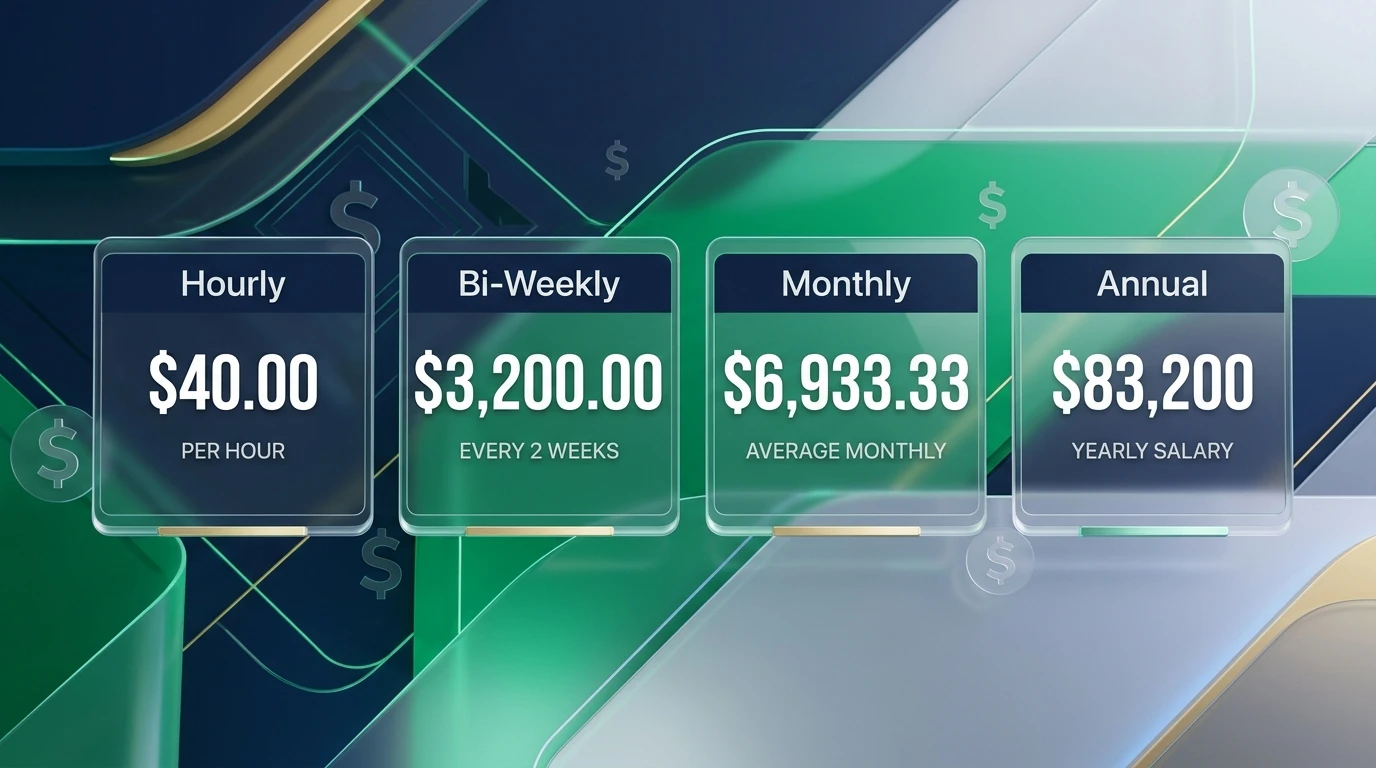
Earning $40 an hour on a standard full-time schedule (40 hours per week, 52 weeks per year) produces a gross annual salary of exactly $83,200 per year before taxes. If you take two weeks of unpaid time off (working 50 weeks or 2,000 hours per year), your gross income is $80,000 per year.
Whether you have recently received a wage increase to $40 an hour, are evaluating a new job offer, or are planning to transition from salaried employment to hourly contracting, calculating your exact earnings is essential for accurate financial planning. Gross income tells only part of the story. Between federal income taxes, state taxes, FICA withholdings (Social Security and Medicare), and employer healthcare deductions, your actual net take-home pay determines what you can spend on housing, groceries, investments, and personal goals.
In this comprehensive financial guide, we break down every dimension of earning $40 an hour: exact paycheck breakdowns across daily, weekly, bi-weekly, and monthly cycles, detailed statutory tax withholdings across 12 major US states, realistic 50/30/20 budgeting frameworks, housing and mortgage affordability benchmarks, and overtime earnings potential.
Complete $40 an Hour Paycheck Conversion Table (Gross vs. Estimated Net)
Depending on your employer's payroll schedule, you may receive your wages weekly (52 paychecks per year), bi-weekly (26 paychecks per year), semi-monthly (24 paychecks per year), or monthly (12 paychecks per year). The table below outlines your gross earnings and estimated take-home pay based on standard full-time employment (40 hours per week, 2,080 hours per year) assuming an average baseline tax withholding of 21% (federal income tax and FICA):
How the 2,080-Hour Formula Converts $40 an Hour to Salary
In standard corporate accounting and United States Department of Labor standards, full-time employment is defined as 40 hours per week across 52 weeks in a calendar year:
Annual Salary = $40 × 2,080 Hours = $83,200
However, whether you actually earn $83,200 depends significantly on your company's paid time off (PTO) policy and paid federal holidays:
- With Paid Time Off (PTO): If your employer provides 2 to 3 weeks of paid vacation and paid sick leave, you are compensated for all 52 weeks (2,080 hours), guaranteeing your full $83,200 gross salary.
- Unpaid Time Off (2 Weeks Vacation): If you work as an hourly contractor, freelancer, or temp employee without paid leave and take two weeks off, you work 50 weeks (2,000 hours):
$40 × 2,000 = $80,000 gross. - Unpaid Time Off (4 Weeks Vacation): If you take four weeks of unpaid time off across the year (working 48 weeks or 1,920 hours):
$40 × 1,920 = $76,800 gross.
$40 an Hour After Taxes: Complete Federal & State Breakdown
Taxes are the single largest deduction from your earnings. In the United States, your paycheck is subject to mandatory federal payroll taxes, progressive federal income taxes, and, depending on where you reside, state and local income taxes.
1. Federal Payroll Taxes (FICA)
All wage earners in the US contribute to Social Security and Medicare via the Federal Insurance Contributions Act (FICA):
- Social Security Tax: 6.2% on gross earnings up to the annual wage cap ($176,100 statutory maximum wage base). On $83,200, your Social Security deduction is exactly $5,158.40 per year ($429.87/month).
- Medicare Tax: 1.45% on all earnings with no cap. On $83,200, Medicare withholding is $1,206.40 per year ($100.53/month).
- Total FICA Tax: 7.65% = $6,364.80 per year ($530.40/month or $244.80 per bi-weekly paycheck).
2. Federal Income Tax Brackets (Single Filer)
Federal income tax is calculated on taxable income after subtracting the Standard Deduction ($15,000 standard deduction for single filers):
- Gross Income: $83,200
- Standard Deduction: -$15,000
- Taxable Income: $68,200
- 10% Bracket (First $11,925): $1,192.50
- 12% Bracket ($11,925 to $48,475): $4,386.00
- 22% Bracket ($48,475 to $68,200): $4,339.50
- Total Estimated Federal Income Tax: $9,918.00 (Effective Federal Tax Rate: ~11.92%)
Combined, your total federal tax burden (Income Tax + FICA) is approximately $16,282.80, leaving an estimated federal take-home pay of $66,917.20 per year ($5,576.43 per month) before state taxes.
State-by-State Take-Home Pay Comparison on $40 an Hour ($83,200)
Your physical location dramatically shapes your disposable income. States without state income taxes save you thousands of dollars each year compared to high-tax coastal states:
| State | State Tax Rate | Est. State Tax | Annual Net Pay | Monthly Net Pay | Bi-Weekly Net |
|---|---|---|---|---|---|
| Texas | 0.00% (No Tax) | $0.00 | $66,917 | $5,576 | $2,574 |
| Florida | 0.00% (No Tax) | $0.00 | $66,917 | $5,576 | $2,574 |
| Washington | 0.00% (No Tax) | $0.00 | $66,917 | $5,576 | $2,574 |
| Tennessee / Nevada | 0.00% (No Tax) | $0.00 | $66,917 | $5,576 | $2,574 |
| Pennsylvania | 3.07% (Flat) | -$2,554 | $64,363 | $5,364 | $2,476 |
| Illinois | 4.95% (Flat) | -$3,960 | $62,957 | $5,246 | $2,421 |
| North Carolina | 4.50% (Flat) | -$3,450 | $63,467 | $5,289 | $2,441 |
| Georgia | 5.39% (Flat) | -$3,890 | $63,027 | $5,252 | $2,424 |
| New York (State Only) | ~5.50% (Progressive) | -$3,950 | $62,967 | $5,247 | $2,422 |
| California (Inc. SDI) | ~6.5% + 1.1% SDI | -$5,365 | $61,552 | $5,129 | $2,367 |
Realistic 50/30/20 Monthly Budget on $40 an Hour ($5,350 Average Net)
The 50/30/20 budgeting rule, popularized by personal finance experts, is one of the most effective methods to balance living expenses, lifestyle freedom, and wealth accumulation. Assuming an average monthly net take-home pay of $5,350 per month (after federal and moderate state taxes):
Essential survival costs required to maintain employment and basic quality of life:
- Rent / Mortgage: $1,700 - $1,900
- Utilities (Electric, Water, Internet): $250
- Groceries & Household Essentials: $400
- Auto Insurance & Gas / Transit: $250
- Health Insurance Copays: $75
Discretionary expenses that enhance your lifestyle and personal enjoyment:
- Dining Out & Coffee: $450
- Entertainment & Subscriptions: $150
- Shopping, Apparel & Gadgets: $300
- Vacation & Travel Fund: $450
- Gym Membership & Hobbies: $255
Financial defense and aggressive wealth building for long-term independence:
- Emergency Fund Savings: $350
- Roth IRA / 401(k) Contribution: $500
- Extra Debt Principal / Brokerage: $220
- Annual Wealth Accumulation: $12,840/year
Housing & Rent Affordability on $40 an Hour
A primary financial question when earning $40 an hour is: What rent can I comfortably afford, and can I qualify to buy a home?
The 30% Gross Income Rent Rule
Financial planners recommend spending no more than 28% to 30% of your gross monthly income on rent or total housing costs:
- Gross Monthly Income: $6,933.33
- Maximum Recommended Monthly Rent (30%): $2,080 per month
- Conservative Rent Target (25%): $1,733 per month
In most US metropolitan areas (including Dallas, Atlanta, Phoenix, Chicago, Charlotte, and Tampa), a monthly rent budget of $1,700 to $2,000 secures a modern, spacious 1-bedroom or 2-bedroom apartment with premier amenities. However, in hyper-competitive markets like Manhattan, Brooklyn, San Francisco, or Boston, living comfortably on $40 an hour typically requires having a roommate or living in an outer suburb.
Can You Buy a House on $40 an Hour?
Mortgage lenders evaluate your Front-End Debt-to-Income (DTI) ratio (housing costs should not exceed 28% of gross income) and Back-End DTI (total debt payments including student loans, car notes, and credit cards should not exceed 36%):
- Maximum Monthly Mortgage Payment (PITI): 28% of $6,933 = $1,941 per month (including principal, interest, property taxes, and homeowners insurance).
- Purchasing Power (Assuming 6.5% Mortgage Rate & 10% Down Payment): Qualifies for a home priced between $270,000 and $320,000, depending on local property tax rates and HOA fees.
Overtime & Varied Schedules: How Extra Hours Multiply Your Pay
Under the federal Fair Labor Standards Act (FLSA), non-exempt hourly employees are entitled to overtime pay at 1.5 times their regular hourly rate for all hours worked exceeding 40 in a single workweek:
Double Time Rate (2.0x): $40.00 × 2.0 = $80.00 per hour
Working just a few overtime hours each week produces a massive increase in annual compensation:
| Hours per Week | Weekly Gross | Bi-Weekly Gross | Monthly Gross | Annual Gross Salary |
|---|---|---|---|---|
| 20 Hours (Part-Time) | $800.00 | $1,600.00 | $3,466.67 | $41,600.00 |
| 30 Hours (Part-Time) | $1,200.00 | $2,400.00 | $5,200.00 | $62,400.00 |
| 35 Hours | $1,400.00 | $2,800.00 | $6,066.67 | $72,800.00 |
| 40 Hours (Standard Full-Time) | $1,600.00 | $3,200.00 | $6,933.33 | $83,200.00 |
| 45 Hours (5 Hours Overtime @ $60/hr) | $1,900.00 | $3,800.00 | $8,233.33 | $98,800.00 |
| 50 Hours (10 Hours Overtime @ $60/hr) | $2,200.00 | $4,400.00 | $9,533.33 | $114,400.00 |
Is $40 an Hour a Good Wage? US Economy & Benchmark Comparison
According to the United States Bureau of Labor Statistics (BLS), the median individual annual earnings for full-time American wage and salary workers is approximately $59,500 per year ($28.60 per hour). The median household income in the US sits near $77,500 per year.
At $83,200 per year:
- You earn roughly 40% more than the typical American individual worker.
- A single earner making $40 an hour earns more than the entire median US household.
- You are positioned in the top 35% of all individual income earners nationwide.
- In middle-cost-of-living (MCOL) and low-cost-of-living (LCOL) states, $40 an hour provides a genuinely upper-middle-class standard of living, allowing comfortable homeownership, reliable car financing, frequent vacations, and robust retirement contributions.
Part-Time vs Full-Time Breakdown at $40 an Hour
Not every hourly worker clocks standard 40-hour weeks throughout the entire year. Whether you are freelancing, working part-time, or balancing flexible consulting schedules, here is exactly how your gross income scales from 15 to 60 hours per week at $40 per hour:
| Weekly Hours | Weekly Gross | Bi-Weekly Gross | Monthly Gross | Annual Gross (52 Wks) |
|---|---|---|---|---|
| 15 Hours (Part-Time) | $600.00 | $1,200.00 | $2,600.00 | $31,200.00 |
| 20 Hours (Half-Time) | $800.00 | $1,600.00 | $3,466.67 | $41,600.00 |
| 25 Hours (Part-Time) | $1,000.00 | $2,000.00 | $4,333.33 | $52,000.00 |
| 30 Hours (Part-Time) | $1,200.00 | $2,400.00 | $5,200.00 | $62,400.00 |
| 35 Hours (Sub-Full-Time) | $1,400.00 | $2,800.00 | $6,066.67 | $72,800.00 |
| 40 Hours (Standard Full-Time) | $1,600.00 | $3,200.00 | $6,933.33 | $83,200.00 |
| 45 Hours (5h Overtime @ 1.5x) | $1,900.00 | $3,800.00 | $8,233.33 | $98,800.00 |
| 50 Hours (10h Overtime @ 1.5x) | $2,200.00 | $4,400.00 | $9,533.33 | $114,400.00 |
Paid vs. Unpaid Time Off: What Happens When You Take Vacation?
If you are an hourly employee, whether your holidays and sick days are paid makes a significant difference in your annual take-home compensation. Here is how your annual salary changes based on actual working weeks:
- 52 Weeks Paid (Standard Salaried Equivalent or Paid PTO): Working 2,080 hours earns exactly $83,200 gross. Even while on approved paid vacation, you receive your full $1,600 weekly check.
- 50 Weeks Paid (2 Weeks Unpaid Vacation): Working 2,000 hours results in $80,000 gross, reducing your annual earnings by $3,200.
- 48 Weeks Paid (4 Weeks Unpaid Time Off): Working 1,920 hours yields $76,800 gross, representing a $6,400 reduction from the full-time baseline.
W-2 Employee vs. 1099 Independent Contractor on $40 an Hour
A crucial trap many professionals fall into is assuming that $40/hour as a 1099 contractor equals $40/hour as a W-2 employee. In reality, they are drastically different:
| Compensation Element | W-2 Employee ($40/hr) | 1099 Contractor ($40/hr) |
|---|---|---|
| Gross Annual (2,080 hrs) | $83,200.00 | $83,200.00 |
| FICA / Self-Employment Tax | 7.65% ($6,364.80) | 15.3% SE Tax (~$11,756.00) |
| Employer Tax Match | Employer pays matching 7.65% | None (You pay both halves) |
| Health & Dental Benefits | Subsidized (~$6,000 value/yr) | 100% out-of-pocket (~$500/mo) |
| Paid Time Off (PTO) | 2 to 4 weeks typical | Zero ($0 earned on vacation) |
| True Equivalent Hourly Rate | Baseline $40.00/hr | Must bill $52.00 - $58.00/hr to match W-2 net |
High-Demand Careers That Pay $40 an Hour Without a Graduate Degree
Reaching an $83,200 annual salary does not require spending six figures on a master's degree. Across healthcare, technology, skilled trades, and enterprise operations, many roles pay median wages of $40/hour ($83,200/year) with an associate degree, trade apprenticeship, or industry certifications:
- Dental Hygienist ($42.00 - $48.50/hr): Requires an accredited 2-year Associate Degree in Dental Hygiene and state licensure.
- Registered Nurse (RN) ($39.00 - $47.00/hr): Entry-level ADN (Associate Degree in Nursing) or BSN graduates routinely command over $40/hour in acute care, surgical, and ICU settings.
- Web & Software Developer ($40.00 - $55.00/hr): Frontend, full-stack, and Python automation engineers frequently hit $40/hour within 2 to 3 years through technical skill, bootcamps, and real-world project portfolios.
- Master Electrician / Commercial HVAC Technician ($38.00 - $49.00/hr): Skilled trade professionals finishing 4- to 5-year paid apprenticeships achieve high demand and strong overtime multipliers.
- Diagnostic Medical Sonographer ($39.50 - $48.00/hr): Ultrasound and cardiovascular technologists earn excellent hourly compensation following a 2-year allied health program.
- Commercial Airline / Corporate Pilot Flight Instructor ($38.00 - $46.00/hr): Certified flight instructors (CFI/CFII) building multi-engine turbine hours.
How to Negotiate Your Rate From $40 to $45 or $50 an Hour
Increasing your rate by just $5.00/hour (from $40 to $45) adds $10,400 per year in gross income ($83,200 up to $93,600). Moving to $50/hour crosses the six-figure threshold into $104,000/year. Use these evidence-backed strategies:
- Quantify Measurable Output: Frame your achievements in dollars saved, revenue generated, or pipeline accelerated rather than hours worked.
- Leverage Market Benchmark Data: Present verified compensation percentiles from BLS and local industry salary guides to establish fair market compensation.
- Propose Performance-Tied Stepped Increases: If an employer hesitates at an immediate jump to $48/hour, propose a written review after 90 days tied to specific KPI milestones.
- Bundle High-Value Cross-Functional Skills: Adding cloud certification (AWS/Azure), specialized machinery licenses, or bilingual fluency significantly increases hourly leverage.
Frequently Asked Questions (FAQ) About $40 an Hour
How much is $40 an hour a year after taxes?
For a single filer, $40 an hour ($83,200 gross) yields approximately $66,917 per year ($5,576/month) in zero-income-tax states like Texas and Florida. In moderate-tax states (Pennsylvania, Illinois, North Carolina), take-home pay is roughly $63,000 to $64,300 per year. In high-tax states like California and New York, annual net pay is approximately $61,500 to $63,000.
How much is $40 an hour bi-weekly after taxes?
On a standard 80-hour bi-weekly pay schedule (26 pay periods per year), your gross paycheck is $3,200.00. After federal income tax (~$381) and FICA payroll taxes (~$245), your baseline federal take-home pay is $2,574.00 per paycheck. If state taxes apply, net bi-weekly pay ranges between $2,367 and $2,475.
How much is $40 an hour monthly after taxes?
Your gross monthly salary at $40 an hour is $6,933.33 ($83,200 divided by 12 months). After federal and state taxes, your monthly take-home pay averages between $5,129 (California) and $5,576 (Texas/Florida).
Can you live comfortably on $40 an hour in the United States?
Yes, absolutely. In over 85% of American cities and suburbs, $83,200 allows a single adult to live comfortably, maintain reliable private transportation, save over $1,000 monthly, and comfortably afford 1-bedroom or 2-bedroom rental accommodations under $1,800/month.
What is $40 an hour part-time?
At 20 hours per week, $40 an hour equals $800 weekly and $41,600 per year gross. At 25 hours per week, it equals $1,000 weekly and $52,000 per year. At 30 hours per week, it equals $1,200 weekly and $62,400 per year.