

Using an accurate sleep calculator is the secret to waking up refreshed, alert, and energized every single morning without feeling groggy or fatigued. Millions of people struggle with chronic morning exhaustion, believing that getting more total hours of sleep is the only solution. However, human sleep architecture is governed by biological 90-minute circadian cycles rather than raw accumulated hours. If your alarm sounds in the middle of deep slow-wave sleep, you will experience severe sleep inertia regardless of whether you slept for six hours or nine hours. Understanding how a sleep calculator works empowers you to plan optimal bedtimes and wake-up windows based on natural sleep cycles.
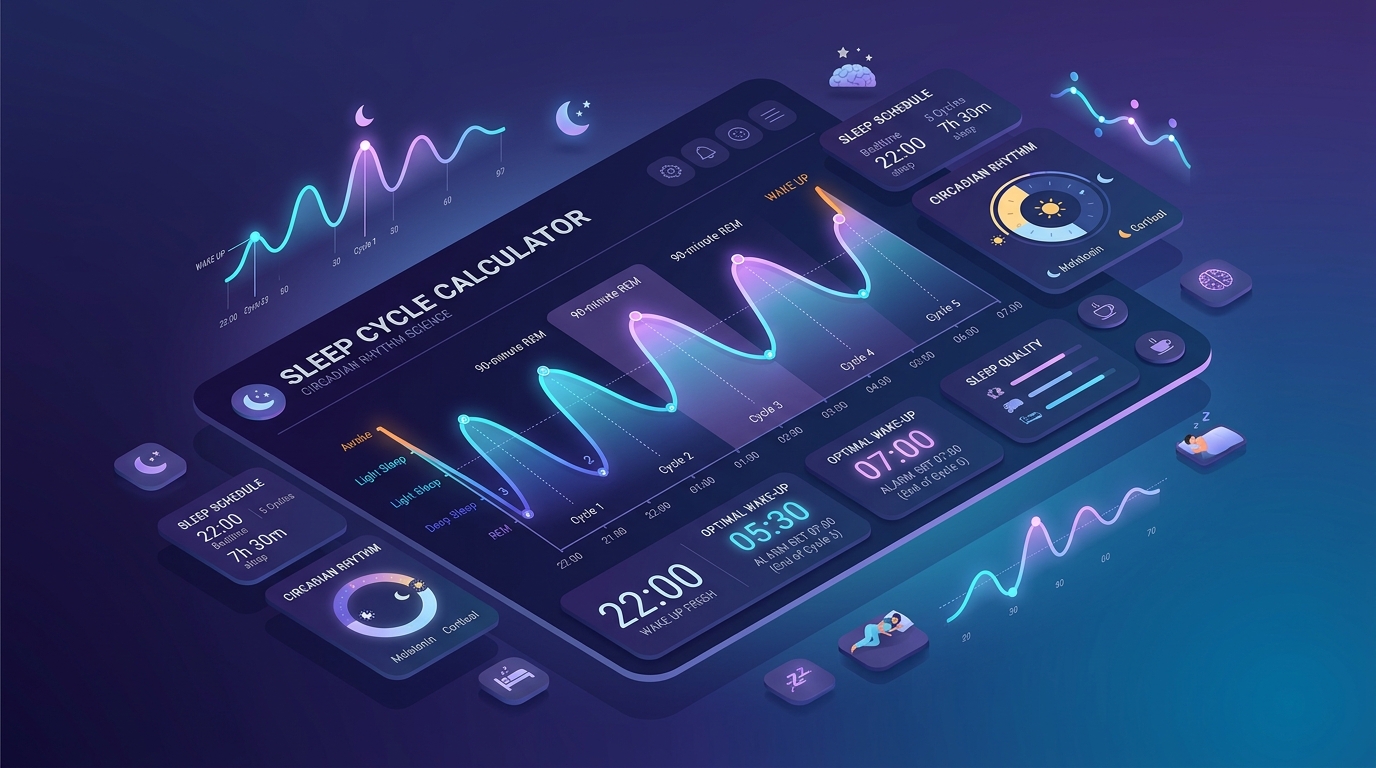
Quick Key Takeaways: The Science of Sleep Timing
- A complete human sleep cycle lasts approximately 90 minutes, cycling through Light Sleep (N1, N2), Deep Slow-Wave Sleep (N3), and Rapid Eye Movement (REM) sleep.
- The average adult takes approximately 14 to 15 minutes to fall asleep after getting into bed (known clinically as sleep latency).
- Waking up at the end of a completed 90-minute cycle leaves you feeling alert, while waking up mid-cycle triggers severe grogginess (sleep inertia).
- For optimal cognitive performance and physical repair, target 5 full cycles (7.5 hours) or 6 full cycles (9 hours) per night.
What is a Sleep Calculator and How Does It Work?
A sleep calculator is an algorithmic scheduling tool designed to calculate ideal bedtimes and wake-up times based on clinical chronobiology and human sleep stage transitions. Rather than focusing solely on a generic recommendation of eight hours, the calculator works backward from your required alarm time (or forward from your intended bedtime) using 90-minute mathematical multiples.
The standard mathematical formula utilized by modern sleep calculators is:
For example, if you must wake up at 6:30 AM to commute to work, counting backward reveals multiple optimal bedtimes:
- 6 Cycles (9.0 Hours of Sleep): Bedtime at 9:15 PM (Allows 15 minutes to fall asleep + 9 hours of sleep).
- 5 Cycles (7.5 Hours of Sleep): Bedtime at 10:45 PM (The gold standard for working adults).
- 4 Cycles (6.0 Hours of Sleep): Bedtime at 12:15 AM (Acceptable for short-term busy schedules).
- 3 Cycles (4.5 Hours of Sleep): Bedtime at 1:45 AM (Emergency short night, but avoids deep-sleep alarm shock).
The 4 Stages of a 90-Minute Sleep Cycle Explained
To appreciate why timing matters more than duration, you must understand what happens inside the human brain during each 90-minute cycle. Clinical polysomnography divides human sleep into four distinct stages:
Stage 1: NREM 1 (Light Transitional Sleep / 5–10 Minutes)
Stage 1 marks the boundary between wakefulness and light slumber. Your brain waves slow from active beta rhythms down to relaxed alpha and theta waves. Your heartbeat, respiration, and eye movements decelerate, and your muscles begin to relax. During this phase, sudden muscle twitches (hypnic jerks) frequently occur. If awakened during Stage 1, you may feel as though you never actually fell asleep.
Stage 2: NREM 2 (Light Baseline Sleep / 45–50% of Total Sleep)
During Stage 2, your core body temperature drops, eye movements stop completely, and your heart rate settles into a steady, restorative pace. Brain activity produces sudden bursts of rhythmic electrical oscillation known as sleep spindles and K-complexes. These neurochemical spikes protect the brain from external auditory disturbances and facilitate long-term memory consolidation.
Stage 3: NREM 3 (Deep Slow-Wave Sleep / Physical Restoration)
Stage 3 is the deepest, most physically restorative phase of human sleep, characterized by slow, high-amplitude delta brain waves. During deep slow-wave sleep:
- Human growth hormone (HGH) surges, triggering tissue repair, muscle growth, and cellular regeneration.
- The brain's glymphatic system activates, flushing out toxic metabolic waste products, including beta-amyloid plaques.
- Blood pressure drops to its lowest daily point, providing vital cardiovascular recovery.
Crucial Fact: If an alarm shocks you awake during Stage 3, you will experience profound grogginess, disorientation, impaired motor skills, and brain fog that can persist for up to 4 hours. This debilitating phenomenon is known clinically as sleep inertia.
Stage 4: REM Sleep (Rapid Eye Movement / Mental & Emotional Integration)
Approximately 90 minutes after first drifting off, your brain transitions into REM sleep. Your brain wave activity accelerates to levels resembling awake consciousness, your eyes dart rapidly behind closed eyelids, and your major voluntary muscles enter temporary paralysis (atonia) to prevent you from physically acting out your dreams.
REM sleep is essential for complex problem-solving, creative synthesis, emotional regulation, and neuroplastic learning. In healthy adults, REM periods lengthen as the night progresses, meaning the final two hours of morning sleep are heavily concentrated in REM.
Sleep Cycle Master Reference Table: Optimal Bedtimes by Wake-Up Hour
Use this comprehensive reference table to identify your ideal bedtime based on common morning alarm times. All calculations include a clinical 15-minute sleep latency buffer:
| Target Wake-Up Time | 6 Cycles (9h Sleep) | 5 Cycles (7.5h Sleep) [Recommended] | 4 Cycles (6h Sleep) | 3 Cycles (4.5h Sleep) |
|---|---|---|---|---|
| 5:00 AM | 7:45 PM | 9:15 PM | 10:45 PM | 12:15 AM |
| 5:30 AM | 8:15 PM | 9:45 PM | 11:15 PM | 12:45 AM |
| 6:00 AM | 8:45 PM | 10:15 PM | 11:45 PM | 1:15 AM |
| 6:30 AM | 9:15 PM | 10:45 PM | 12:15 AM | 1:45 AM |
| 7:00 AM | 9:45 PM | 11:15 PM | 12:45 AM | 2:15 AM |
| 7:30 AM | 10:15 PM | 11:45 PM | 1:15 AM | 2:45 AM |
| 8:00 AM | 10:45 PM | 12:15 AM | 1:45 AM | 3:15 AM |
Why 7.5 Hours of Sleep Frequently Feels Better than 8 Hours
One of the most common paradoxes reported by health enthusiasts is waking up exhausted after sleeping for exactly eight hours, yet feeling remarkably energized after sleeping for seven and a half hours. This experience is not psychological; it is purely mathematical:
- At 7.5 Hours (450 Minutes): You complete exactly five 90-minute sleep cycles (5 x 90 = 450). When your alarm sounds at the 450-minute mark, your brain has naturally transitioned out of REM back into Stage 1 light sleep. Waking up during light sleep triggers an immediate release of cortisol and alertness hormones.
- At 8.0 Hours (480 Minutes): You are 30 minutes into your sixth sleep cycle. At the 30-minute mark of a new cycle, your brain is descending rapidly into deep Stage 3 slow-wave delta sleep. Shocking your body out of deep sleep disrupts cellular restoration, leaving you groggy, disoriented, and reaching desperately for caffeine.
The 4 Sleep Chronotypes: Customizing Your Schedule to Your Genetic Clock
Clinical sleep research pioneered by Dr. Michael Breus demonstrates that human circadian rhythms are genetically hardwired into four distinct chronotypes. Understanding your personal chronotype allows you to adjust your sleep calculator schedule for maximum daily productivity:
1. The Bear Chronotype (50–55% of the Population)
Bears follow the solar cycle naturally. They wake easily around sunrise (7:00 AM) and experience peak cognitive focus between 10:00 AM and 2:00 PM. Bears should target bedtimes around 11:00 PM to hit five complete cycles before a 6:30 AM or 7:00 AM alarm.
2. The Lion Chronotype (15–20% of the Population)
Lions are natural early birds. They wake energized at 5:00 AM or 5:30 AM without needing an alarm, reach peak productivity before noon, and fatigue quickly by 9:00 PM. Lions thrive on a 9:30 PM bedtime to maintain 5 full cycles.
3. The Wolf Chronotype (15–20% of the Population)
Wolves are authentic night owls. Their internal circadian clocks run slightly longer than 24 hours. Wolves struggle intensely with 6:00 AM alarms and reach peak creative and analytical velocity between 5:00 PM and midnight. Wolves function best targeting bedtimes around 12:30 AM to 1:00 AM and waking up around 8:00 AM or 8:30 AM.
4. The Dolphin Chronotype (10% of the Population)
Dolphins are light, fragmented sleepers prone to insomnia. They possess high underlying intelligence and neuroticism, frequently waking during minor environmental noises. Dolphins function best on a structured 4-cycle schedule (6 hours), sleeping from 11:45 PM to 6:00 AM with consistent bedtime routines.
The Power Nap Formula: 20-Minute Power Nap vs. 90-Minute Full-Cycle Nap
When you cannot hit five full cycles at night, strategic daytime napping can restore cognitive alertness. However, taking a random 45-minute nap often causes severe afternoon grogginess. Follow clinical napping guidelines:
1. The 20-Minute Power Nap (Stage 1 & 2 Only)
Setting a timer for 25 minutes (5 minutes to drift off + 20 minutes of sleep) limits your nap to Stage 1 and Stage 2 light sleep. A 20-minute nap sharpens reaction times, boosts working memory, and relieves sensory fatigue without ever entering Stage 3 deep sleep.
2. The 90-Minute Full-Cycle Rejuvenation Nap
If you are severely sleep-deprived from shift work or a red-eye flight, allocate a full 90-minute window. This allows your brain to complete one full cycle of light sleep, deep slow-wave physical repair, and REM cognitive integration. You wake up naturally during light sleep without post-nap disorientation.
Scientific Strategies to Optimize Sleep Latency (Falling Asleep in Under 15 Minutes)
A sleep calculator is only accurate if your sleep latency buffer matches reality. If you toss and turn for an hour before falling asleep, your calculations will be thrown off. Implement these evidence-based sleep hygiene habits:
- Eliminate High-Intensity Blue Light 90 Minutes Before Bed: Short-wavelength blue light (450–480 nm) emitted by smartphones, laptops, and LED screens suppresses pineal melatonin secretion by up to 85%. Switch devices to night mode, wear amber blue-blocking glasses, or engage in analog reading before bed.
- Maintain a Cool Ambient Bedroom Temperature (18°C–19°C / 65°F–68°F): To initiate sleep, your core body temperature must drop by roughly 1°C. A room that is too warm traps body heat and prevents descent into Stage 3 slow-wave sleep.
- The 10-3-2-1-0 Sleep Optimization Framework:
- 10 hours before bed: No more caffeine (allowing adenosine clearance).
- 3 hours before bed: No heavy food meals or alcohol (preventing nighttime acid reflux and fragmented REM).
- 2 hours before bed: Stop strenuous physical workouts.
- 1 hour before bed: Shut down work emails and digital screens.
- 0: The number of times you hit the morning snooze button.
Frequently Asked Questions (FAQ)
How long is an average human sleep cycle?
The average human sleep cycle lasts approximately 90 minutes. However, depending on individual physiology, sleep debt, and age, cycle durations can range between 80 and 110 minutes throughout the night. Earlier cycles in the evening contain more deep slow-wave sleep, while morning cycles are dominated by REM sleep.
Is 6 hours of sleep enough if I complete 4 sleep cycles?
Four full cycles (6 hours) is biologically adequate for short periods and will prevent morning sleep inertia because you wake at the end of a cycle. However, chronic 6-hour sleep schedules lead to cumulative sleep debt, impaired immune function, and reduced REM emotional processing. Aim for 5 complete cycles (7.5 hours) for sustainable long-term health.
Why do I wake up tired after 8 hours of sleep?
At exactly 8 hours (480 minutes), you are 30 minutes into your sixth sleep cycle, which is typically the deepest Stage 3 slow-wave sleep. Awakening during deep sleep triggers intense sleep inertia, leaving your brain foggy and sluggish for hours. Waking up 30 minutes earlier at 7.5 hours (at the end of cycle 5) often leaves you feeling dramatically more alert.
How long does it take an average person to fall asleep?
Clinical sleep studies indicate that healthy adults take between 10 and 20 minutes to transition from wakefulness to Stage 1 sleep, with 14 to 15 minutes being the clinical median. If you fall asleep in under 5 minutes, you may be severely sleep-deprived; if it takes longer than 30 minutes, you may be experiencing sleep latency insomnia.
Does hitting the snooze button disrupt sleep cycles?
Yes, hitting the snooze button is one of the worst habits for morning energy. Snoozing for 9 or 10 minutes fragments your sleep and sends your brain into the beginning of a brand-new 90-minute sleep cycle that it cannot finish. When the second alarm rings, you wake up deeper in the cycle, compounding morning fatigue.
Conclusion: Take Control of Your Energy with Precise Sleep Timing
Sleep is not an arbitrary block of unconscious time; it is a precision biological cycle governed by delicate neurochemical rhythms. By using a sleep calculator to align your bedtimes and morning wake-up hours with natural 90-minute cycle boundaries, you can eliminate morning grogginess, accelerate daily cognitive performance, and optimize your overall physical wellbeing.
Pair your sleep scheduling with balanced nutrition and proper hydration. Explore our companion wellness utilities, including our Water Intake Calculator and TDEE Calculator, to build a comprehensive foundation for peak daily energy and vitality.