

Aggregate Engineering Summary: Sizing bulk gravel accurately requires three consecutive mathematical operations: calculating the volume in cubic yards using the formula ((Length in feet x Width in feet x Depth in inches) / 324), adding a 10% to 15% compaction allowance to account for mechanical settling and subgrade penetration, and converting cubic yards into purchasing tons by multiplying by material density (typically 1.4 tons per cubic yard for clean washed drainage stone, or 1.5 to 1.6 tons per cubic yard for dense graded crusher run base rock). Ordering correct tonnage prevents costly split-load freight charges and eliminates project stalls.
The Mathematics of Bulk Aggregates: Cubic Yards and Square Footage
Whether you are installing a gravel driveway, grading an RV parking pad, establishing garden walkways, or constructing a subsurface French drainage trench, gravel is rarely sold by simple bags at wholesale quarries. Commercial aggregate suppliers, gravel pits, and landscape material yards quote and sell bulk materials by two primary units of measure: Cubic Yards (volume) and Tons (weight).
Understanding the conversion between linear footprint dimensions (feet), depth requirements (inches), volumetric capacity (cubic yards), and weight tonnage is essential for realistic material budgeting and freight planning.
The Universal 324 Cubic Yard Formula
In the construction and landscape trades, measuring project length and width is naturally performed in feet, whereas material depth is specified in inches. Rather than converting all dimensions into fractional feet first, professionals utilize the unified 324 Formula:
Cubic Yards = ( Length in Feet x Width in Feet x Depth in Inches ) / 324
The mathematical origin of the 324 constant is straightforward:
- One cubic yard measures 3 feet by 3 feet by 3 feet = 27 cubic feet.
- To convert depth from inches into feet, depth in inches is divided by 12.
- Therefore: Volume (Cubic Yards) = (Length ft x Width ft x (Depth in / 12)) / 27 = (Length ft x Width ft x Depth in) / (27 x 12) = 324.
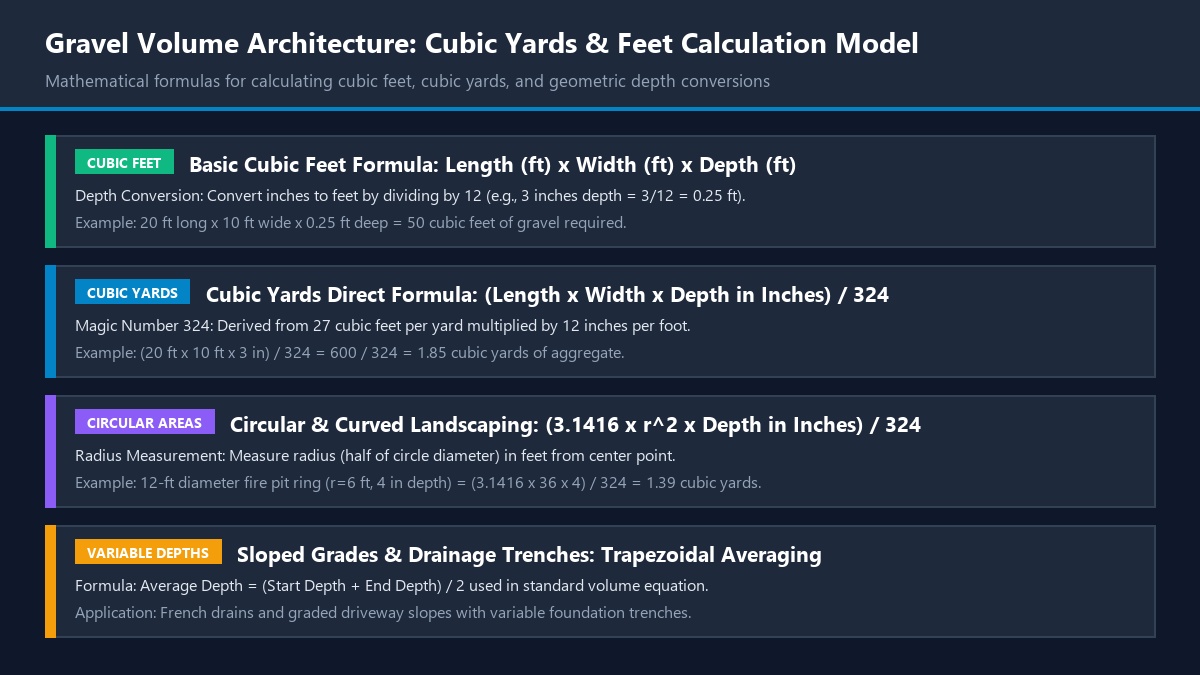
Figure 1: The mathematical architecture of aggregate volumetric calculations and the 324 cubic yard formula derivation.
Direct Square Footage Coverage Method
If you already know the total square footage of your project area (for example, a 1,200 square foot driveway), divide your square footage by the coverage factor for your desired depth:
Cubic Yards = ( Square Footage x Depth in Inches ) / 324
For example, covering a 1,200 square foot driveway with 3 inches of top gravel requires:
( 1,200 sq ft x 3 inches ) / 324 = 11.11 Cubic Yards (uncompacted baseline).
Converting Cubic Yards to Tons: Aggregate Density Factors
While cubic yards determine the physical trench or roadway cavity that must be filled, commercial scale houses at aggregate quarries weigh dump trucks on certified platform scales to bill by the Short Ton (2,000 pounds).
Because gravel is a natural geological product, different rock types and grain sizes possess substantially different bulk densities. Dense, angular crushed stone with fines packs tightly together, weighing significantly more per cubic yard than clean, rounded pea gravel.
| Aggregate Type & Sizing | Material Composition | Density (Tons / Cu Yd) | Weight Per Cubic Foot | Primary Engineering Use |
|---|---|---|---|---|
| Crusher Run / Road Base (DGB) | 3/4 inch fractured stone down to rock dust | 1.50 - 1.60 Tons | 111 - 118 lbs/cu ft | Driveway foundation, compaction base, pavers |
| #57 Crushed Stone (3/4" Clean) | Uniform angular stone, no rock dust / fines | 1.35 - 1.40 Tons | 100 - 104 lbs/cu ft | Driveway wearing top coat, French drains |
| Pea Gravel (3/8" Smooth) | Naturally rounded alluvial river pebbles | 1.40 - 1.45 Tons | 104 - 107 lbs/cu ft | Garden walkways, dog runs, playground mulch |
| River Rock (1" to 3" Smooth) | Smooth rounded decorative river stone | 1.45 - 1.50 Tons | 107 - 111 lbs/cu ft | Dry creek beds, bioswales, decorative borders |
| Decomposed Granite (DG) | Weathered granite fines with small gravel | 1.55 - 1.65 Tons | 115 - 122 lbs/cu ft | Rustic garden trails, bocce courts, xeriscaping |
| Rip Rap (4" to 8" Rock) | Heavy angular quarry ballast boulders | 1.40 - 1.50 Tons | 104 - 111 lbs/cu ft | Culvert headwalls, ditch erosion control |
The mathematical conversion from volume to weight is:
Total Weight (Tons) = Cubic Yards x Material Density Factor (Tons/Cu Yd)
For standard estimating when rock density is unknown, construction professionals apply the reliable benchmark multiplier of 1.4 tons per cubic yard for clean gravel, and 1.5 tons per cubic yard for dense road base mixtures.
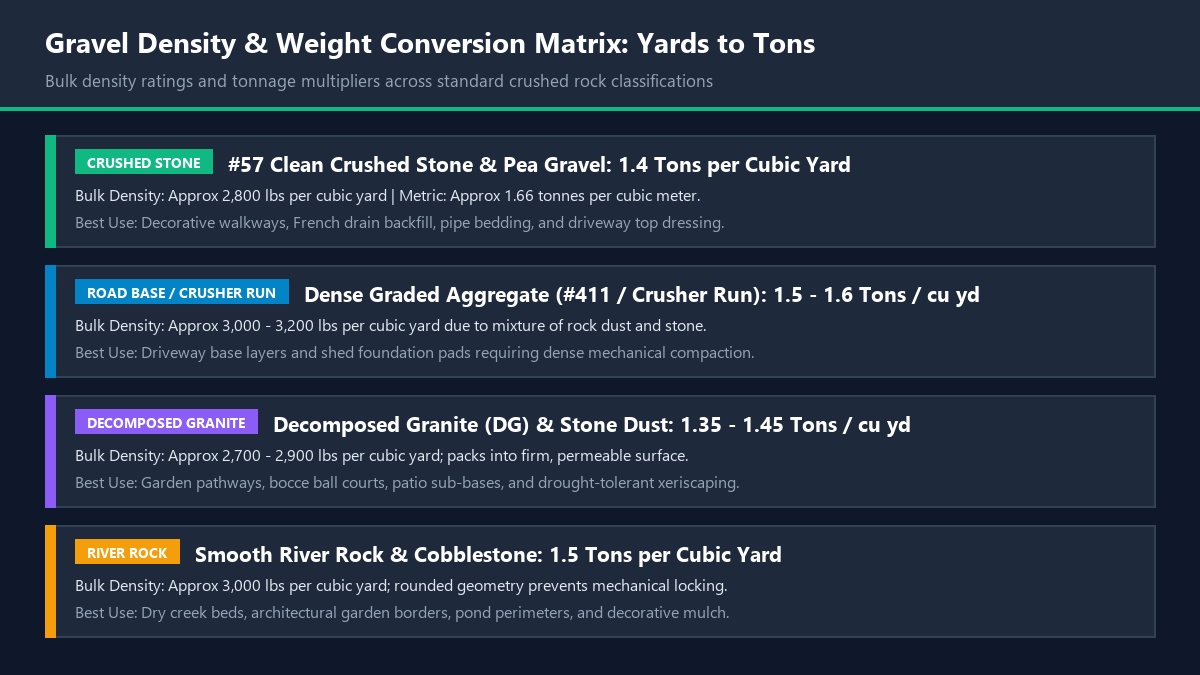
Figure 2: Empirical bulk density multipliers for converting cubic yard volumes to purchase tons across six aggregate classifications.
Depth Standards by Project Application
Choosing the incorrect gravel depth compromises functional performance. Gravel spread too thin exposes underlying soil and geotextile fabric, allowing wheel ruts and weeds to emerge. Conversely, gravel placed too deep without structural interlocking creates loose, shifting gravel that vehicle tires spin out in, similar to driving on loose beach sand.
| Installation Category | Recommended Depth | Ideal Aggregate Sizing | Subgrade Requirement | Compaction Method |
|---|---|---|---|---|
| Garden Footpath / Walkway | 2 to 3 Inches | 3/8" Pea Gravel or Decomposed Granite | Woven landscape fabric over compacted soil | Hand tamper or water-filled lawn roller |
| Residential Driveway (Base Layer) | 4 to 6 Inches | 1.5" to 2.5" Crusher Run / #3 Stone | Non-woven geotextile stabilization fabric | Vibratory plate compactor (2,000+ lbs force) |
| Residential Driveway (Top Surface) | 2 to 3 Inches | 3/4" Angular Crushed Stone (#57) | Firmly compacted base rock layer | Vehicle tire rolling or smooth drum roller |
| Heavy Vehicle / RV Parking Pad | 8 to 10 Inches (2 Lifts) | Dense Graded Aggregate with 3/4" top | High-strength woven geotextile Class 1 | Heavy vibratory roller in 4-inch lifts |
| French Drain Drainage Trench | 8 to 18 Inches | 3/4" to 1.5" Washed Drainage Stone | Filter fabric wrapping pipe and stone burrito | Light hand tamping to avoid pipe crushing |
| Decorative Landscape Bed / Mulch | 2 to 3 Inches | 1" to 2" Decorative River Rock / Slate Chips | Heavy-duty needle-punched landscape fabric | Raked level, no mechanical compaction |
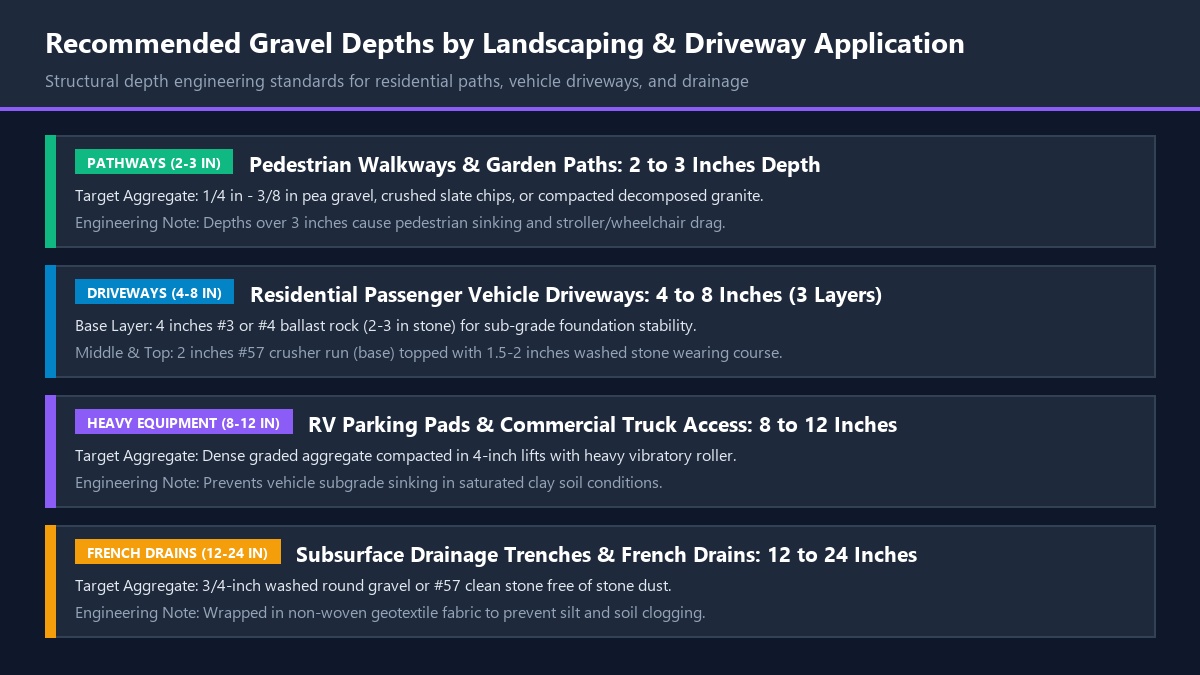
Figure 3: Recommended depth standards, aggregate sizing grades, and subgrade stabilization requirements across common residential scenarios.
The Science of Compaction: Accounting for Settling and Subgrade Loss
One of the most frequent miscalculations committed by DIY homeowners is ordering aggregate based solely on loose uncompacted trench dimensions. When gravel is dumped from a truck tailgate, it lands in an aerated, loose state containing 30% to 40% empty void space between stone fragments.
As soon as a mechanical vibratory plate compactor runs across the surface, or heavy passenger trucks drive over the driveway, angular rock fragments rotate, lock together, and settle into interstitial voids. This mechanical compaction reduces the physical thickness of the layer by 10% to 15%.
In addition, if gravel is spread directly over damp clay or sandy topsoil without an intervening geotextile separation barrier, the bottom 1 to 2 inches of stone will be driven downward into the soft subgrade under vehicle wheel pressure.
The Compaction Safety Multiplier
To guarantee your project achieves its engineered finished depth after full mechanical compaction, apply the appropriate safety factor:
- Clean Washed Stone (No Fines): Compacts approximately 10%. Multiply net calculated cubic yards by 1.10.
- Crusher Run / Road Base (With Fines): Compacts significantly more due to dust filling voids, losing 15% to 20% of loose volume. Multiply net calculated cubic yards by 1.15 to 1.20.
- Soft Clay Subgrades (No Geotextile Fabric): Add an additional 10% to account for soil migration, resulting in a total overage multiplier of 1.25.
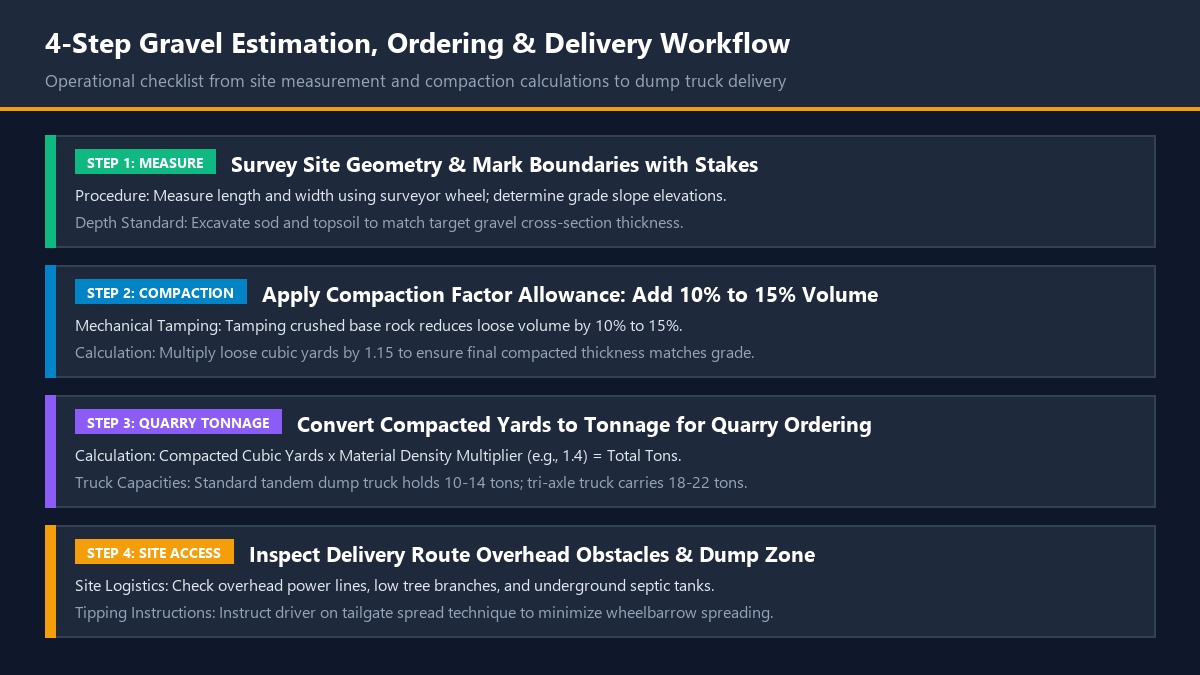
Figure 4: End-to-end procurement flowchart from site dimension measurements to compaction allowances, truck logistics, and delivery execution.
Delivery Logistics: Dump Truck Types, Site Clearances, and Spreading Methods
Ordering bulk aggregate involves coordinating physical delivery to your property. Knowing truck capacities and site limitations prevents property damage and unnecessary labor.
1. Commercial Dump Truck Capacity Classes
- Single-Axle Dump Truck: Carries 5 to 8 tons (roughly 4 to 6 cubic yards). Highly maneuverable, featuring a short wheelbase suitable for narrow suburban driveways, tight mountain curves, and standard residential gates without cracking concrete curbs.
- Tandem-Axle Dump Truck: Carries 12 to 16 tons (roughly 8 to 11 cubic yards). The workhorse for residential construction. Requires adequate overhead clearance and firm roadway shoulders.
- Tri-Axle / Quad-Axle Dump Truck: Carries 18 to 22 tons (roughly 13 to 16 cubic yards). Delivers maximum economy per ton of freight, but weighs over 60,000 pounds fully loaded. Can easily crack thin residential concrete driveways, crush septic drain fields, and sink into soft turf.
2. The Tailgate Spreading Technique ("Belly Spreading")
Skilled dump truck drivers can perform a "tailgate spread" upon request. The driver chains the bottom of the dump tailgate so it opens only 4 to 6 inches, elevates the hydraulic bed, and slowly drives forward at 3 to 5 miles per hour. The aggregate dispenses in an even ribbon across the roadway at approximately your target depth.
Tailgate spreading saves hours of intense physical labor with hand wheelbarrows and shovels. However, tailgate spreading requires:
- A straight, unobstructed driving path without sharp turns.
- Absolute zero overhead power lines, telephone cables, or low-hanging tree branches along the entire route (an elevated dump bed extends 15 to 22 feet into the air).
- Firm, dry ground that can support the truck's moving gross weight without sinking.
Long-Term Maintenance: Weed Suppression, Edging, and Crown Profiling
A gravel installation is an active civil system that requires periodic maintenance to preserve drainage efficiency and prevent surface degradation.
1. Geotextile Fabric Separation: Preventing Subgrade Contamination
The single most critical longevity factor for gravel driveways and walkways is the installation of high-quality geotextile fabric between the subgrade dirt and the bottom stone layer. Standard black perforated plastic weed barrier sold in garden centers tears easily under rock weight.
Installers must specify heavy-duty woven or non-woven needle-punched polypropylene geotextile fabric (minimum 4 to 6 ounces per square yard). Geotextile fabric serves two essential functions:
- Subgrade Separation: Prevents stone from sinking into soft subsoil while preventing underlying clay mud from pumping upward through the gravel bed during spring thaw cycles.
- Weed Barrier: Prevents perennial weed roots from taking anchor in the native earth below, keeping maintenance to minimal spot-spraying of windborne seeds that germinate in surface dust.
2. Establishing a Driveway Crown for Stormwater Runoff
Standing water is the primary cause of potholes in gravel roadways. When vehicle tires drive through standing puddles, hydraulic pressure forces fine particles out of the aggregate, scouring a hollow crater that rapidly expands into a severe pothole.
To eliminate standing water, grade the driveway with a center crown. The center spine of the roadway must be shaped 2 to 3 inches higher than the outer edges (a 2% to 4% cross-slope). Stormwater sheds immediately into flanking drainage swales before it can pool on the driving surface.
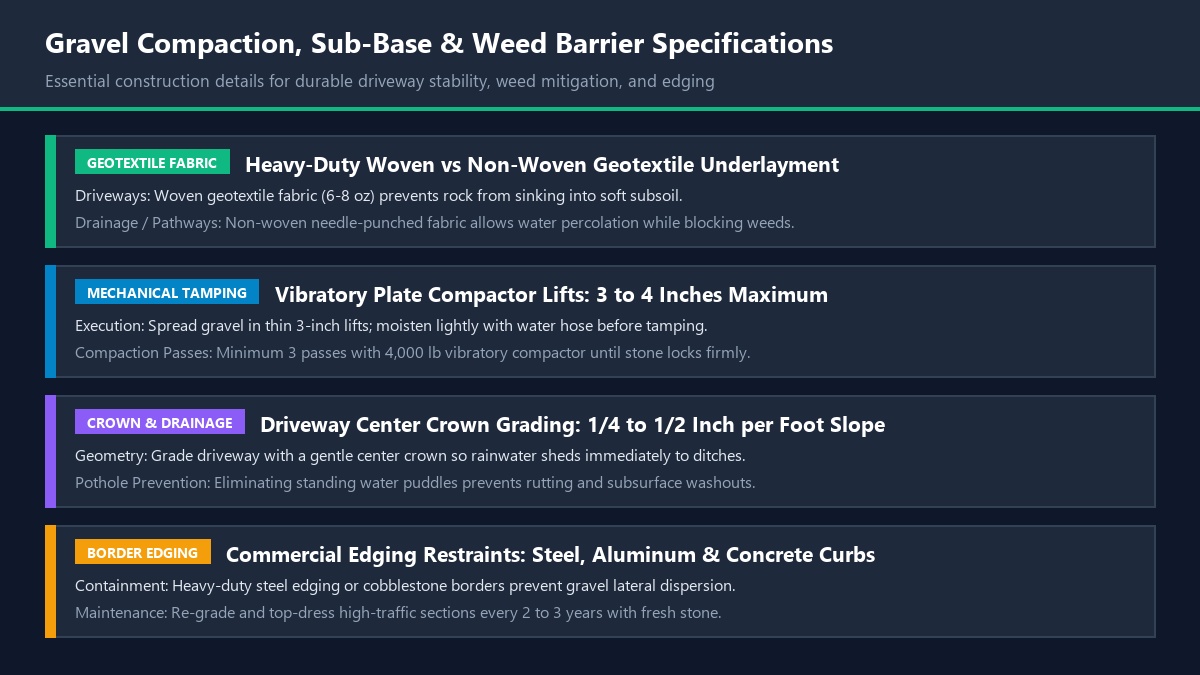
Figure 5: Driveway cross-section crown profiling, edge restraint options, pothole repair protocols, and seasonal maintenance schedules.
Cost Breakdown: Sourcing Aggregate, Delivery Fees, and Labor Rates
Budgeting a gravel project involves balancing material quarry pricing, trucking transportation freight, and mechanical equipment rental expenses:
| Budget Item Category | DIY Procurement Cost | Full Professional Installation | Cost Determinants |
|---|---|---|---|
| Bulk Crushed Stone / Base Rock | $18 - $35 per Ton | $25 - $45 per Ton (marked up) | Quarry proximity, regional geology, rock hardness |
| Decorative Pea Gravel / River Stone | $45 - $85 per Ton | $60 - $110 per Ton | Washing, round tumbling, color aesthetics |
| Trucking Delivery Freight Fee | $75 - $150 flat load fee | Included in turnkey bid | Distance from quarry (typically $5 to $8/mile past 15 miles) |
| Heavy-Duty Geotextile Fabric | $0.25 - $0.45 per Sq Ft | $0.60 - $1.00 per Sq Ft installed | Fabric weight rating (4 oz vs 8 oz woven) |
| Equipment Rental (Compactor / Skid-Steer) | $85/day (Plate) to $250/day (Bobcat) | Included in contractor fee | Machine horsepower, trailer transport, fuel |
| Contractor Grading & Installation Labor | $0 (Personal Sweat Equity) | $1.50 - $3.50 per Sq Ft | Subgrade excavation, slope leveling, obstacle clearing |
| Total Cost per Square Foot | $0.80 - $1.75 / Sq Ft | $2.50 - $5.50 / Sq Ft | Overall project scope and site accessibility |
Step-by-Step Driveway Construction Protocol
Building a lasting aggregate driveway follows a disciplined civil engineering sequence:
Step 1: Layout Marking and Excavation
Mark the perimeter of the driveway using survey stakes and high-visibility marking paint. Excavate topsoil and organic humus down to firm, stable mineral subsoil (typically 6 to 8 inches below target finished grade). Remove tree roots, organic debris, and large boulders.
Step 2: Subgrade Compaction and Fabric Placement
Run a heavy vibratory plate compactor across the raw excavated earth to eliminate soft air pockets. Roll out heavy-duty non-woven geotextile stabilization fabric across the excavated trench, overlapping all roll seams by at least 18 inches. Pin the fabric in place with steel landscape staples.
Step 3: Base Rock Layer Installation (Crusher Run)
Deposit the first 4-inch lift of dense graded aggregate or #3 crushed stone base. Spread the material evenly using a tractor box blade or landscape rake. Moisten the stone lightly with a water hose to activate mineral fines, then compact thoroughly with a commercial vibratory roller or plate compactor.
Step 4: Top Wearing Course Spreading and Crowning
Spread 2 to 3 inches of clean 3/4-inch angular crushed stone (#57 stone) over the compacted base. Grade the surface with a slight crown running down the center centerline, pitching downward at a 2% to 4% grade toward the perimeter edges. Compact the surface lightly to seat the stones without crushing the crown profile.
Frequently Asked Questions About Gravel Calculations
How many tons of gravel are in one cubic yard?
On average, one cubic yard of gravel weighs approximately 1.4 tons (2,800 pounds). For dense graded base aggregate containing stone dust and compaction fines, weight increases to roughly 1.5 to 1.6 tons per cubic yard.
How much square footage does one ton of gravel cover?
At a standard depth of 2 inches, one ton of gravel covers approximately 100 to 110 square feet. At a depth of 3 inches, coverage decreases to roughly 70 to 80 square feet. At a heavy base depth of 4 inches, one ton covers approximately 50 to 55 square feet.
Why should I avoid using round pea gravel on a driveway?
Round pea gravel acts like miniature ball bearings under vehicle weight. Because round pebbles lack angular fractured edges, they cannot mechanically interlock. Vehicle tires push round stones aside, creating deep wheel ruts and causing cars to lose traction. Driveways must always utilize angular crushed stone that locks into a rigid, stable driving surface.
What is the difference between #57 stone and crusher run?
#57 stone is washed angular stone screened to a uniform size (roughly 1/2 to 1 inch) with all rock dust removed, providing excellent drainage. Crusher run (also known as road base or ABC stone) blends 3/4-inch crushed stone with fine rock dust. When compacted and dampened with water, the rock dust cements the larger stones together into a rock-hard, unyielding foundation.
How thick should a gravel driveway be?
A proper residential gravel driveway requires a total combined thickness of 6 to 8 inches. This structure consists of a 4 to 6-inch compacted base layer of coarse crusher run, topped by a 2 to 3-inch wearing surface of 3/4-inch angular crushed stone.
Can a dump truck deliver gravel directly onto my lawn?
It is strongly discouraged. A loaded dump truck weighs between 30,000 and 65,000 pounds. Driving onto residential lawn turf will create deep tire trenches, sever shallow underground sprinkler lines, damage tree root networks, and risk cracking underground water mains or septic tanks. Have gravel delivered onto a firm asphalt, concrete, or existing gravel surface.
Subsurface French Drains and Hydrological Retention Trenches
Beyond vehicular driveways and pedestrian footpaths, bulk gravel plays an indispensable role in residential stormwater management. Surface water accumulation around building foundations leads to basement water intrusion, hydrostatic foundation wall cracking, and saturated soils that kill turf grass.
A traditional French drain system captures subsurface ground water and channels it safely away from home foundations by gravity flow. Calculating aggregate volume for drainage trenches requires understanding trench geometry and soil void dynamics:
1. Trench Volumetric Sizing and Pipe Displacement
A standard residential perimeter French drain trench measures 12 to 18 inches wide and 18 to 24 inches deep, running alongside foundation footings or across low lawn swales:
- Trench Volume Calculation: Apply the standard 324 formula: (Trench Length in feet x Trench Width in feet x Trench Depth in inches) / 324. For a 100-foot-long drainage trench measuring 12 inches (1.0 foot) wide and 18 inches deep: (100 x 1.0 x 18) / 324 = 5.55 Cubic Yards of gross trench volume.
- Perforated Pipe Displacement: French drains incorporate a 4-inch perforated drainage pipe (typically smooth-wall rigid SDR 35 PVC or corrugated perforated HDPE). A 4-inch pipe has an outer diameter of approximately 4.2 inches, displacing roughly 0.10 cubic feet per linear foot. For a 100-foot trench, the pipe displaces 10 cubic feet = 0.37 Cubic Yards.
- Net Drainage Stone Volume: Gross volume (5.55 yards) minus pipe displacement (0.37 yards) = 5.18 Cubic Yards of drainage stone required. Adding a 10% settling allowance yields 5.7 Cubic Yards (approximately 8.0 Tons of washed stone).
2. The Aggregate 'Burrito Wrap' Filtration Method
Never pour drainage gravel directly against raw trench dirt walls. Native clay and silt particles will be washed into the gravel bed by rainwater, filling the microscopic void spaces between stones and clogging the French drain within two to three rainy seasons.
To ensure lifetime drainage performance, employ the engineered Burrito Wrap method:
- Line the bottom and vertical walls of the excavated trench with an oversized roll of non-woven needle-punched geotextile drainage fabric (4 oz weight rating). Leave 12 to 18 inches of excess fabric flapping over both top edges of the trench.
- Deposit a 2 to 3-inch bedding layer of washed #57 stone along the trench bottom.
- Lay the 4-inch perforated pipe directly onto the stone bed, with the perforation holes oriented downward toward the 4 o'clock and 8 o'clock positions (this allows groundwater to enter the pipe from the bottom as the water table rises).
- Backfill the trench with clean washed stone up to 2 inches below finished surface grade.
- Fold the overlapping flaps of geotextile fabric over the top of the stone bed, completely encapsulating the aggregate and pipe inside a closed fabric envelope. Top the sealed envelope with a shallow layer of topsoil and sod, or top with decorative river rock.
Geocellular Gravel Permeable Paver Grids (Eco-Grids)
A modern civil engineering innovation for gravel stabilization is the deployment of interlocking geocellular permeable paving grids (such as TrueGrid, BodPave, or Core Gravel). These hexagonal or square honeycomb structures are manufactured from 100% recycled high-density polyethylene (HDPE).
1. Structural Load Dissipation and Zero Rutting
When gravel is poured into an unconfined roadway, vehicle tires apply concentrated downward point loads, forcing stones outward and downward to create ruts. When gravel is contained within interlocking geocellular grid cells:
- Cellular Confinement: The vertical walls of the plastic grid trap aggregate particles within rigid 2-inch by 2-inch honeycomb cells, completely preventing lateral displacement.
- Compressive Load Capacity: Once filled with angular aggregate, permeable grid pavers achieve compressive load ratings exceeding 8,000 to 10,000 pounds per square foot (over 550 psi). This easily supports heavy commercial delivery vehicles, fully loaded concrete transit mixers, and municipal fire apparatus without sinking.
- Zero Wheel Rutting and Raking: The gravel surface remains flat and firm indefinitely. Homeowners can roll heavy rolling trash bins, wheelbarrows, and strollers across the surface with zero rolling resistance.
2. ADA Compliance and Wheelchair Accessibility
Standard loose gravel fails compliance with Americans with Disabilities Act (ADA) accessibility guidelines because loose stone displaces under narrow wheelchair caster wheels, trapping users. However, permeable gravel grid systems filled with compacted 3/8-inch angular aggregate create a firm, stable, slip-resistant surface that complies fully with ADA standards for accessible pathways.
Pothole Remediation and Washboarding Mechanics
Over time, high-traffic gravel driveways and rural access roads can develop two characteristic surface defects: washboarding (corrugations) and potholes. Resolving these defects requires understanding their physical mechanics.
1. The Physics of Washboarding (Corrugation)
Washboarding consists of a series of rhythmic transverse ridges and valleys that ripple across the roadway surface, creating severe vehicle vibration. Washboarding is not caused by rain or wind; it is caused by vehicle suspension bounce:
- When vehicles accelerate, brake abruptly, or travel faster than 15 miles per hour over unbonded gravel, tires undergo micro-hops. Upon landing, the tire kicks loose aggregate backward, carving a hollow trough and building a compacted crest.
- Once initiated, every subsequent vehicle tire hits the ripple and bounces at the exact same resonant frequency, amplifying the wave pattern along the roadway.
- Remediation: Washboarding cannot be repaired by filling the troughs with loose gravel. A tractor box blade or motor grader equipped with carbide scarifier teeth must rip the corrugated gravel bed down to a depth of 3 to 4 inches, pulverizing the hard crests. The aggregate is then rewetted, re-graded with a 3% crown, and compacted with a vibratory roller.
2. The Correct Way to Repair a Gravel Pothole
Most property owners repair potholes incorrectly by simply dumping a shovel of loose stone into the depression. Within two weeks, vehicle tires throw the loose stone right out, and the pothole reappears larger than before.
To perform a permanent pothole repair:
- Excavate and Square the Hole: Use a pickaxe or mattock to cut the edges of the pothole into vertical 90-degree walls. Never leave sloped, feathered edges. Excavate 2 inches below the bottom of the crater to remove soft, saturated soil.
- Scarify the Base: Loosen the compacted soil at the bottom of the hole so the new material can interlock mechanically with the base.
- Fill with Dense Graded Crusher Run: Fill the hole with 3/4-inch crusher run base rock containing stone dust (do not use clean washed stone). Fill the hole in 2-inch lifts.
- Moisten and Tamp: Spray each lift with water, then compact with a heavy steel hand tamper or mechanical tamper until the stone rings like concrete under the blow.
- Crown Slightly Above Grade: Leave the final patch crowned roughly 1/2 inch higher than the surrounding driveway surface to account for future settling under vehicle tires.
Winter Snow Removal and Ice Management on Aggregate Surfaces
Clearing snow from a gravel driveway requires modifying standard snow removal equipment to avoid scraping surface stone into adjacent lawn turf:
- Plow Blade Skid Shoes: When using a truck-mounted snow plow, adjust the heavy-duty cast-iron skid shoes downward to elevate the steel cutting edge 1.0 to 1.5 inches above the gravel surface. This leaves a thin snowpack layer while preventing the steel plow blade from catching frozen stone clusters or stripping the crown.
- Rubber or Polyurethane Cutting Edges: Replace rigid steel plow cutting edges with thick polyurethane or recycled rubber cutting edges. Flexible rubber edges ride smoothly over surface gravel variations without gouging rocks into the ditch.
- Snow Blower Clearance: Adjust the skid plates on your two-stage snow blower to lift the auger housing 1 inch off the ground. If the auger runs directly on gravel, it will ingest rocks and propel them at lethal velocities through the discharge chute, damaging vehicles and home siding.
- De-Icing Material Selection: Avoid heavy applications of rock salt (sodium chloride) on gravel roadways bordered by landscaping. Melted salt runoff penetrates through the porous gravel into bordering ditches, burning lawn edges and poisoning ornamental shrubs. Instead, spread coarse traction sand or fine aggregate grit across icy surfaces to provide mechanical traction without toxic chemical runoff.
Subgrade Soil Mechanics: The California Bearing Ratio (CBR)
The structural foundation of any aggregate installation is the native subgrade earth beneath the gravel bed. In civil engineering, soil load-bearing capacity is measured using the California Bearing Ratio (CBR) test:
| Soil Classification | Typical CBR Rating | Subgrade Structural Stability | Required Gravel Base Thickness | Geogrid Reinforcement Need |
|---|---|---|---|---|
| Heavy Plastic Clay / Muck | CBR < 2% | Extremely weak, severe rutting, pumps mud when wet. | 10 to 14 Inches (Multi-lift) | Mandatory Triaxial Geogrid |
| Silty Clay / Sandy Clay | CBR 3% - 5% | Moderate stability, prone to seasonal frost heave. | 6 to 8 Inches | Recommended Class 1 Geotextile |
| Well-Graded Sand / Sandy Gravel | CBR 6% - 10% | Good natural drainage and load-bearing strength. | 4 to 6 Inches | Standard Landscape Fabric |
| Dense Fractured Rock / Shale | CBR > 15% | Excellent unyielding bedrock foundation. | 2 to 3 Inches (Wearing layer only) | Not Required |
Conducting a Subgrade Proof-Roll Test
Before laying aggregate, professional road contractors conduct a practical field verification called a Proof-Roll Test. A fully loaded tandem-axle dump truck (weighing 30,000+ lbs) drives slowly down the excavated subgrade at 2 to 3 miles per hour.
An inspector watches the tires contact the soil. If the tires create depressions exceeding 1 inch, or if the soil "pumps" (deflects downward and rebounds like a rubber mattress), the subgrade has failed proof-rolling. The soft soil must be excavated ("undercut"), replaced with coarse surge stone, or reinforced with structural geogrid before placing the base gravel course.
Extended Frequently Asked Questions About Aggregate Calculations
What is the mathematical formula for circular gravel fire pits and round pads?
To calculate cubic yards for a circular area: Volume (Cu Yds) = (3.1416 x Radius in feet x Radius in feet x Depth in inches) / 324. For a 20-foot diameter circular patio (10-foot radius) with 3 inches of pea gravel: (3.1416 x 10 x 10 x 3) / 324 = 2.91 Cubic Yards (roughly 4.1 tons).
Why do landscape suppliers charge different delivery rates for split loads?
A standard dump truck bed has a single cargo bay. If a project requires 5 tons of base crusher run and 5 tons of decorative top river stone, the truck cannot haul both simultaneously without mixing them together. The driver must make two separate round trips to the quarry, incurring two distinct freight delivery fees.
How often does a gravel driveway need replenishment stone?
Under normal residential traffic, a well-built gravel driveway requires a surface top-dressing replenishment of 1 to 2 inches of stone every 2 to 4 years. Regular annual maintenance consists of re-grading the surface in spring to restore the center crown and redistribute displaced shoulder gravel back onto the roadway.
Geotextile and Geogrid Engineering Specifications for Civil Roadbeds
Specifying subgrade geosynthetics requires matching physical engineering parameters to site soil characteristics. Generic landscape weed barrier degrades rapidly under heavy dynamic loading. Civil road projects utilize two distinct classes of geosynthetics governed by ASTM testing standards:
| Geosynthetic Material | ASTM Test Standard | Tensile Grab Strength | Water Permeability / Flow Rate | Primary Engineering Function |
|---|---|---|---|---|
| Non-Woven Geotextile (4 to 8 oz) | ASTM D4632 / ASTM D4491 | 120 - 225 lbs | 90 - 140 gpm/sq ft | Drainage filtration, French drains, separation |
| Woven Stabilization Fabric (Class 1) | ASTM D4632 / ASTM D4833 | 300 - 375 lbs | 4 - 10 gpm/sq ft | Subgrade stabilization under heavy driveways |
| Biaxial / Triaxial Geogrid (Tensar) | ASTM D6637 / ISO 10319 | 1,200 - 2,500 lbs/ft | 100% Open Aperture | Mechanical aggregate interlock over soft clay |
In geogrid installations, individual angular base rock pieces wedge firmly into the open grid aperture openings (typically 1.5 to 2.0 inches wide). As wheel loads press down, the rock cannot shift laterally, creating a stiffened structural slab effect that distributes wheel loads across a broad subsoil footprint.
Permeability and Municipal Stormwater Utility Fee Reductions
Modern urban and suburban municipalities increasingly impose dedicated stormwater utility fees based on a property's total impervious surface area. Solid asphalt and poured concrete surfaces prevent natural rainwater infiltration, generating high-velocity runoff that overloads municipal storm sewer networks and causes localized flooding.
1. Hydrological Runoff Coefficients Compared
Civil engineers measure surface permeability using the Rational Runoff Coefficient (C), which denotes the proportion of rainfall that converts directly into surface runoff (ranging from 0.00 for 100% absorption to 1.00 for completely impervious surfaces):
- Poured Concrete and Asphalt Driveways: Runoff coefficient of 0.80 to 0.95 (near total runoff into drainage systems).
- Compacted Dense Graded Gravel (Crusher Run): Runoff coefficient of 0.40 to 0.60 (absorbs roughly half of rainfall before generating runoff).
- Clean Washed Stone and Permeable Eco-Grid Systems: Runoff coefficient of 0.15 to 0.25 (absorbs over 75% to 85% of rainfall directly into the ground water aquifer).
2. Qualifying for Municipal Stormwater Credits
By opting for a permeable gravel driveway or porous parking apron rather than impermeable asphalt, property owners often qualify for substantial municipal stormwater utility fee discounts (often 25% to 50% annual fee abatements). In jurisdictions with strict zoning lot-coverage caps, permeable aggregate installations often do not count against maximum allowable impervious surface lot coverage limits, permitting larger home footprint construction.
Dust Suppression Techniques for Unpaved Roadways
Dry summer weather and fast vehicular speeds cause rock dust fines to lift from the driveway into the air as airborne dust clouds. Controlling dust preserves driveway binding fines and improves air quality:
- Calcium Chloride (CaCl2) Brine Application: Calcium chloride is a deliquescent chemical salt that naturally extracts moisture from the ambient air and holds it in the roadbed surface. Spreading dry calcium chloride flakes at a rate of 1.0 to 1.5 pounds per square yard keeps the gravel surface slightly damp 24 hours a day, preventing dust fines from blowing away.
- Lignosulfonate (Natural Tree Resin Binder): A non-toxic, eco-friendly byproduct of the paper pulping industry. When sprayed across gravel roadways, lignosulfonate coats dust particles and binds them together into a hardened, cement-like surface crust. It is safe for application adjacent to organic vegetable gardens, pet runs, and freshwater ponds.
- Speed Limit Enforcement: Enforcing a strict 10 to 15 mile per hour vehicular speed limit reduces dust generation by over 80%, as vehicle tire micro-vortex lifting forces increase exponentially above 20 miles per hour.
How do I prevent weeds from growing in my gravel driveway naturally?
To prevent weeds without toxic chemical herbicides, install heavy-duty 6 oz non-woven geotextile fabric beneath the gravel during initial construction. For windborne seeds that blow into surface dust crevices, apply horticultural vinegar (20% to 30% acetic acid) mixed with a tablespoon of dish soap on sunny afternoons. Alternatively, an inexpensive propane weed torch burns foliage in seconds, boiling cellular moisture and eradicating weed root structures permanently.
What is the best time of year to grade and resurface a gravel driveway?
The ideal time to grade and replenish a gravel driveway is late spring, immediately after winter frost has completely thawed and the roadbed retains natural soil moisture. Grading dry gravel in late summer generates heavy dust and fails to achieve dense compaction. Moist springtime aggregate allows grading equipment to slice through surface imperfections smoothly and re-compact the crown into an unyielding, unified matrix before heavy summer vehicle traffic begins.